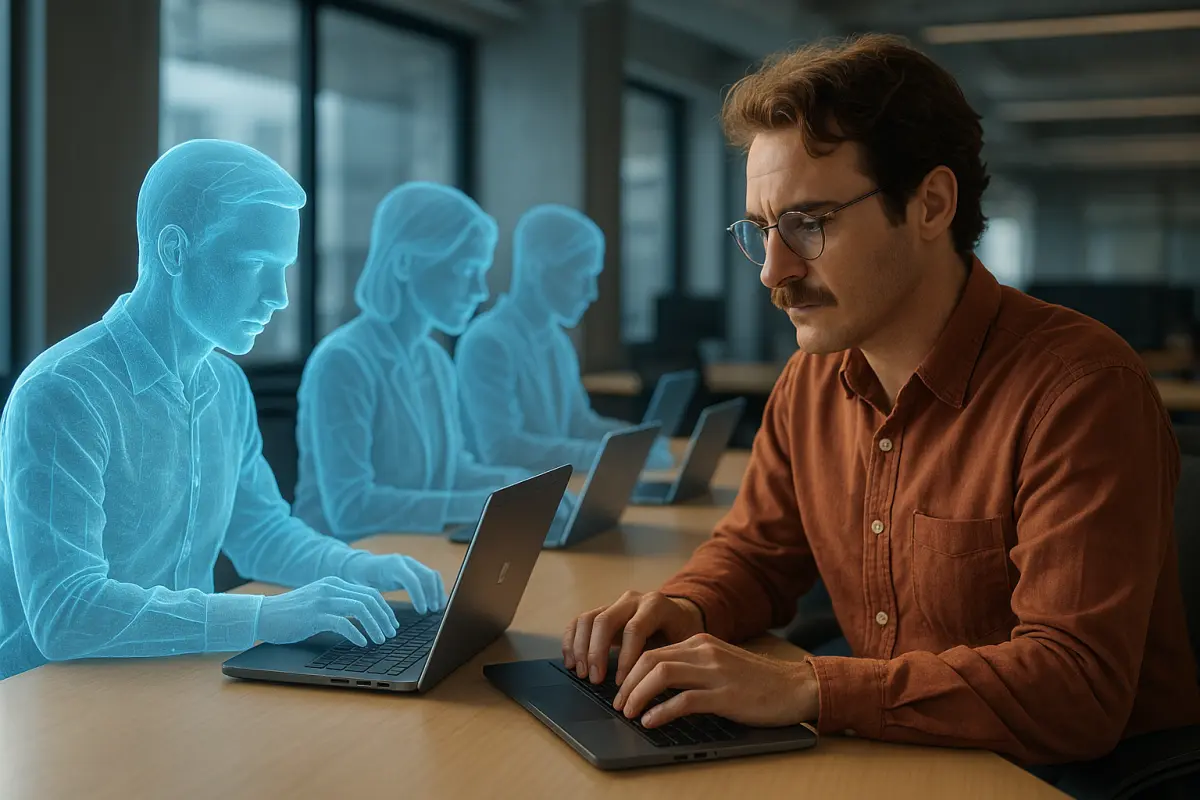

The designer's value is shifting from mocks to being the living judgement and nervous system that holds the product together in real time.
This post is based on the episode "The design process is dead. Here's what's replacing it." from Lenny's Podcast with Jenny Wen (Design at Anthropic, ex Figma).
There is a phrase that has echoed through product teams for months: "we need to adapt". But what is interesting about the conversation between Lenny Rachitsky and Jenny Wen is that it does not start from anxiety, but from an operational reality: engineering has changed so fast that design can no longer follow the classic script.
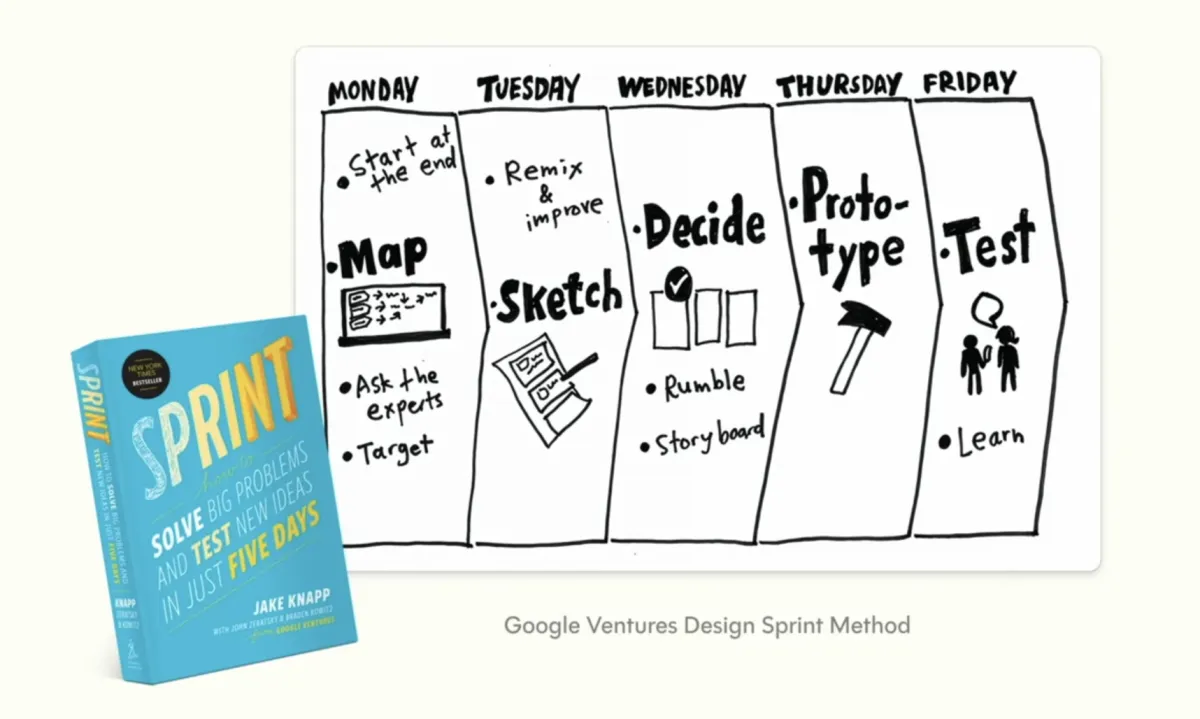
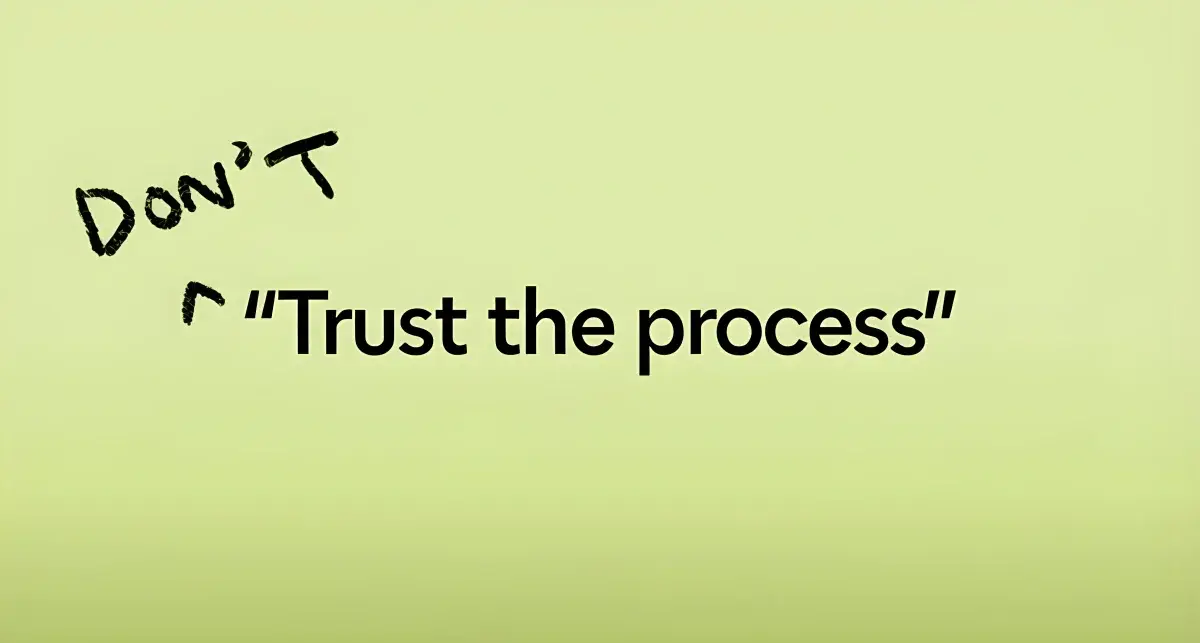
Jenny puts it plainly: the process that was taught for years — discovery, divergence, convergence, flawless mocks, handoff — we treated it as gospel. That gospel no longer organises work when "building" has become too cheap and too fast.
From here, the role of design does not disappear. It mutates. It becomes stratified. It gets closer to the code. It becomes direction and execution at the same time. And, above all, it shifts from being a phase to being the team's nervous system.
1) The death of "process" as a linear sequence
Jenny Wen: "This design process… we treated it as dogma.
That, basically, is dead."
For years, design relied on a clean narrative: research → ideate → prototype → validate → deliver. Even when reality was more chaotic, that structure served as a cultural and pedagogical framework.
Jenny argues that this framework was already weakening before AI, but with the current leap — engineers capable of iterating at agent speed, "her seven Claudes" — the process breaks down entirely.
The reason is simple:
• If the team can materialise ideas in hours,
• if anyone can propose and test a prototype with real data,
• then design can no longer "wait its turn" to produce perfect mocks.
"You don't have time to make beautiful mocks", says Jenny. And she does not say this as a renunciation of craft, but as a shift in the centre of gravity: less representation and more intervention on what is being built.
Key takeaway: when the cost of building falls, design stops being a sequential phase and becomes a continuous practice of alignment and judgement, in real time.
2) A "stratified" design: execution + vision at 3–6 months
Jenny Wen: "We no longer know what's going to happen in two years… it usually becomes a three- or six-month vision."
Jenny describes a new, more polarised map of the work. It is no longer "everyone does a bit of everything" under the standard process, but two broad blocks.
A) Design for execution and implementation: accompanying engineering as it builds (reviewing, connecting, improving, correcting, contributing principles, protecting consistency). Instead of "here is the mock", it is "let's build it together and make it fit".
B) Design as direction (but short-term): previously, vision was packaged in decks spanning 2–5–10 years. Today, that is not reliable: technology changes too quickly. The useful vision is at 3–6 months and often is not a deck, but a prototype that provides orientation.
This matters because when prototypes are being born in parallel, without direction the product fragments. Speed without heading becomes noise.
Key takeaway: the strategic role of design is not lost; it is compressed. Vision stops being "distant future" and becomes an operational compass for 3–6 months that prevents the product from unravelling.
3) The new day-to-day: designing means navigating a constant flow
Jenny Wen: "A good chunk of the time at Anthropic is simply getting up to speed with what's happening in the company."
Part of the work is no longer just "making screens", but keeping up to date: model developments, parallel internal prototypes, directional debates and scattered signals in Slack.
For a designer, this means working with live information: detecting what is being conceived, which prototype has energy, which idea can scale.
In practice, the day-to-day is split between: reserving time to visualise the next quarter, "jamming" with engineering (conversation, whiteboard, feedback), and entering the code for the "last mile" of polish and implementation.
Key takeaway: in high-velocity environments, design looks less like producing artefacts and more like reading signals, making decisions and operating on what has been built.
4) The proportion shifts: fewer mocks, more pairing with engineering
Jenny Wen: "Before, 60% or 70% was mocking and prototyping; now that part is 30% to 40%, and the rest is pairing with engineering and implementing."
Jenny offers a quantitative reference that encapsulates the cultural shift: previously, 60–70% of the time was mocks/prototypes; today, 30–40% mocks, 30–40% direct pairing with engineering, and a further significant share dedicated to implementation.
This alters professional identity: design moves from being "the one who defines it" to being "the one who lands it" alongside engineering, ensuring coherence, legibility and quality of the whole.
Key takeaway: when the product is being built at high speed, design's greatest lever lies in real-time collaboration, not in perfect documentation.
5) AI stack: from chat to long-running work
Jenny Wen: "I've moved most of my use cases to Cowork… and I use Claude Code with VS Code to tweak front-end."
Jenny's stack is a practical manifesto: Claude Chat (increasingly less), Claude Cowork (increasingly more, for long tasks), Claude Code (integrated with VS Code/IDE), and remote use in Slack for targeted changes and PRs.
The value is not in "doing prompts", but in fitting AI into the real workflow: feedback, PRs, polishing and iteration.
Key takeaway: AI contributes most when it is integrated into the working system (PRs, IDE, Slack) rather than remaining as a separate chat tool.
6) Does Figma still matter? Yes, for one reason: exploring without committing
Jenny Wen: "Figma has been great for exploring 8 to 10 options… and for refining visual and interaction details without going straight to code."
Although the "code vs design tools" debate is noisy, Jenny lands on why Figma is still alive: it allows exploring 8–10 options without falling into a linear tunnel.
Code workflows tend to be linear: you commit to a direction and iterate on it. Moreover, Figma remains highly effective for visual micro-decisions and interaction (typography, rhythm, details).
Key takeaway: even in a code-first world, design needs a space to diverge and compare alternatives without becoming trapped in a single path.
7) Maintaining craft, quality and trust when shipping non-stop
Jenny Wen: "We can release it early, but the promise is: we're going to iterate, we're going to take your feedback and we're going to improve it."
The uncomfortable question: if the team ships too fast, does quality degrade? Jenny proposes distinguishing between early preview and mature product, and being explicit when something is a "research preview".
The promise to the user is: "we're putting it out, but we're going to iterate on your feedback." Trust is lost when something launches early and then nothing happens. It is maintained (and reinforced) when there is a response, improvements and a visible cadence of iteration.
Lenny sums it up as "trust through speed": building trust through velocity and the feeling of being heard.
Key takeaway: trust does not depend on shipping perfectly, but on demonstrating the capacity to listen and iterate with a credible cadence.
8) Where will the human mind still be valuable?
Jenny Wen: "At the end of the day, someone has to decide what's actually going to be built and what actually matters."
Jenny does not romanticise "taste" as eternal human territory. She believes AI will improve greatly in taste, judgement and design. But she highlights one point: the hard part of building software is not writing it, but deciding what is worth building when there are disagreements, priorities and trade-offs.
Even though AI can provide data and recommendations, there remains a layer of decision-making and accountability.
Key takeaway: human value shifts from producing to deciding, prioritising and being accountable for what is built.
9) Interfaces: chat is not going away, but it will fill up with generated UI
Jenny Wen: "I don't think chat is going to disappear… but for specific things it will still be more direct to have UI, and increasingly that will be generated by models."
Jenny does not see chat as a temporary phase. She views it as a stable interface because it offers infinite flexibility. At the same time, widgets and clickable components are emerging within the conversational experience.
Her hypothesis: those UIs will increasingly be generated by the model, not designed by hand case by case.
Key takeaway: the future is not "chat or UI", but chat + dynamic UI; and design will need to define the rules, patterns and quality of generated interfaces.
10) Management vs IC: getting your hands dirty again to understand the change
Jenny Wen: "Being IC this year gave me skills I don't think I would have gained if I'd only been managing."
Jenny returned to an IC (Individual Contributor) role at a moment when the process changed radically. She discovered that it allowed her to acquire hard skills she would not have developed by managing all the time.
Her reading: management will continue to be valuable, but less as "pure people management" and more as direction + genuine participation in the work.
Key takeaway: in times of disruption, a good manager needs up-to-date operational competence, not just leadership rituals.
11) Hiring: three designer archetypes for this era
Jenny Wen: "There are three archetypes I'm interested in right now: strong generalists, deep specialists and the craft 'standout new grad'."
Jenny identifies three profiles: (1) strong generalist (very good across several skills), (2) deep "T-shaped" specialist (top 10% in one area), and (3) standout new grad with craft, humility and fast learning.
For those starting out: build real things and share them with the community. Agency, proof of concept, iteration.
Key takeaway: in a changing market, potential is not just seniority: it is the capacity to learn, build and adapt with judgement.
12) Leadership: "low leverage" can be the highest-leverage gesture
Jenny Wen: "Some leaders choose 'low leverage' tasks and end up being 'high leverage'… because they're the ones doing it."
Jenny questions the dogma of delegating everything that is not exclusively the manager's domain. There are apparently low-leverage tasks that become high-leverage when a leader does them: obsessively testing the product, reproducing bugs, getting into PRs, tending to cultural gestures.
It is not the task: it is the message ("I care", "I'm in this", "nothing is beneath me").
Key takeaway: leadership is built through signals. Sometimes the low-leverage becomes high-leverage because of who does it and what it communicates.
13) Teams that "roast" each other: psychological safety + high standards
Jenny Wen: "It can be a good sign when the team feels comfortable joking around… and at the same time knows there are high standards."
This is not about encouraging toxicity. Gentle "roasting" emerges as an indicator of trust: when a team can joke around, real psychological safety tends to exist, even towards the leader.
The counterweight: safety does not mean low expectations. The combination is interpersonal trust + high standards + direct feedback.
Key takeaway: high-performing teams combine trust with explicit rigour; caring and challenging at the same time.
14) The legibility framework: designing as someone who detects illegible ideas
Jenny Wen: "Part of the designer's role is to detect illegible ideas, understand what's there, transform them and put them out into the world."
Jenny takes a VC framework (legible/illegible) and applies it to product. In a lab there are prototypes that nobody fully understands but that generate energy.
The design role can detect that energy, understand what is there, and convert it into something legible (UX, storytelling, form factor) to bring it to the world.
Example: a dense, opaque internal prototype (Claude Studio) generated a signal; pieces from it fed elements that later appeared in Cowork (plans, to-dos, context, files).
Key takeaway: one of design's greatest contributions at the frontier is making the illegible legible — converting raw, energised prototypes into comprehensible and useful experiences.
This is not the end of design
If there is one through-line, it is this: when building stops being the bottleneck, the bottleneck becomes deciding and cohering.
That is why design gets closer to execution, vision gets shorter, it enters the code, protects coherence, builds trust by iterating and becomes the translator of the illegible.
This is not the end of design. It is the end of a comfort: thinking that process protected us. What protects the product now is living judgement, close direction and craft applied where decisions are made: in the implementation.
Three key takeaways
If we had to distil the entire conversation into three actionable ideas, they would be these:
- "Process" is no longer a linear diagram: design integrates into execution and operates in real time to maintain coherence, quality and direction.
- Useful vision gets shorter: in contexts of accelerated change, strategic design works better as a 3–6 month compass (often via prototypes), not as multi-year decks.
- Human value shifts towards judgement and accountability: deciding what to build, prioritising trade-offs and sustaining trust through visible iteration.
Original source
This article is based on the Lenny's Podcast: Product | Career | Growth episode with Jenny Wen (Anthropic): "The design process is dead. Here's what's replacing it."