
Discover how we amplify the rigour of research without losing deep understanding of people.
At Interactius we have moved from reading research reports to conversing with synthetic users created by Clonica©, built from deep qualitative research. I explain how we construct them, how we validate them against real people, and at which moments in the product cycle they help us make faster and better decisions.
When generative AI emerged, at Interactius we found ourselves facing a very clear paradox: on one hand, we had models capable of answering almost anything; on the other, we knew perfectly well that those models were not our users.
I am Lucho Domínguez, Head of Human-Centered AI, and together with Carlos Ruiz, our CEO, we have spent a long time turning over a very specific question: "How can we make the most of AI without losing the most important part of our work: deep understanding of people?"
That is where Clonica© was born — our approach to synthetic users built from qualitative research, with human context and an explicitly humanist perspective.
In this article I want to share, in my own words, the key points from the presentation we gave, why we believe this changes the way digital product teams work, and what we have learned along the way.
From UX to "Augmented Experience": why we took this step
At Interactius we have spent more than 13 years working with large companies in banking, health, fashion, sport, education, retail… always from the perspective of strategic design and research with people.
In recent years we began to feel that "UX" was no longer enough to describe what we were doing. We did not just want to design screens or flows, but to increase organisations' capacity to understand and care for people's experience.
That is why we now talk about Augmented Experience.
When I say "augmented" I am not talking about delegating decisions to an AI, but about something much more concrete:
- Using AI to amplify what we already do well: researching, understanding, designing, prototyping.
- Better connecting research to business decisions.
- Designing augmented experiences (user, employee, agent, customer…) powered by technology to go beyond what a person could do alone.
- Reducing operational friction (recruitment, downtime, waiting) without compromising rigour.
Clonica© is, in a sense, our first major "product" in this direction.
When your user introduces themselves… and then confesses they don't exist
We opened the presentation with a voice that said something like: "Hi, how are you all? Let me introduce myself — I'm Blanca, I'm from Barcelona. I come to Blanc! every year… I follow studios like Soluble, Mendesaltaren and Interactius. Can I tell you a secret? I'm Blanca, but I'm not a real person. I'm a synthetic user created to represent the average attendee of Blanc!."
The interesting thing is not the trick of "I'm not real", but how Blanca had come into being:
- Nobody gave her a script.
- Nobody prepared a super prompt.
- We simply asked her one straightforward question: "Blanca, can you introduce yourself?"
Blanca responded from a corpus of real interviews and surveys with Blanc! attendees: their language, their references, their motivations, their fears. In other words, Blanca is not a random avatar generated by AI: she is the living synthesis of a real segment.
That is what we call a synthetic user: a conversational agent that behaves like a user from a specific segment because it has been built from real qualitative data, not from stereotypes.
What I found unconvincing about generic models
Before arriving at Clonica© I explored several approaches that are widely discussed when people talk about "synthetic personas" — for example, psychological models such as OCEAN / Big Five:
- Values are assigned to five broad personality traits.
- You can say: I want someone highly open, not very extroverted, medium neuroticism, etc.
- With that you parameterise different "personalities".
We also tried approaches based on sociodemographic variables:
- Age, profession, income, education, city, neighbourhood…
- Combine them and the model returns a kind of "standard persona".
The problem, at least for me as a researcher, is that all of that falls short if you do not incorporate human context:
- The way people contradict themselves.
- The things they do not say but that can be sensed.
- The weight of environment: family, neighbourhood, precarity, culture, migration…
- Fear, shame, what others might think.
That is when I saw clearly that I did not want a model that "plays at being a person", but a system that starts from real qualitative research and respects the complexity of those lives.
Clonica© was born precisely for that.
What Clonica© really is and how we build it
When I talk about Clonica©, I am not talking about a magic tool, but about a service that combines:
- Research with real users.
- Curation and modelling of that knowledge.
- And an AI layer that makes it fast, conversational, and actionable.
The process, simplified, looks something like this:
1. Capturing reality (human to human)
The first step is still the same as always:
- In-depth interviews, ethnographies, surveys.
- Contextual observation.
- Long conversations where people contradict themselves, get emotional, hold things back.
We look for what in research is called theoretical saturation: that moment when you start hearing the same things over and over and no new insights are emerging. This is where we know we have the "critical mass" to build something reliable.
2. Converting discourse into a dataset
Then comes the less glamorous but crucial part:
- Cleaning transcripts.
- Grouping fragments.
- Detecting patterns of behaviour, language, fears, expectations.
- Identifying tensions, contradictions, gaps.
With that we build a structured corpus — not just "text", but a fairly faithful mirror of how that segment thinks and lives.
3. Bringing the synthetic user to life
The third phase is giving it shape:
- Defining who that clónico is: age, context, life story.
- Refining how they speak, what references they have, what concerns them.
- Creating their narrative: not from imagination, but from the patterns that emerged from the research.
That is what we did, for example, with Blanca (Blanc! attendee) or with Monse (an older woman living alone who wears a Cruz Roja emergency button).
4. Validating against real users
This is critical for me: we do not simply take the clónico's word for it.
What we do is:
- Ask the same questions to both the clónico and real people from the segment.
- Compare responses:
- Not just the literal words, but the intentions, the nuances, the reasons.
Across different projects we have achieved between 85% and 93% similarity.
In a study with 150 migrants, for example, we reached 93% similarity between the real responses and those of the synthetic user.
When something feels off, we do not paper over it: we go back to the dataset, review, adjust, and repeat.
5. Putting it to work with teams
The final step is integrating it into the day-to-day life of teams:
- Explaining who that clónico is, what they know and what they do not.
- Training the organisation so that it can interact with them.
- Adding an action layer: the clónico does not just answer, but also suggests paths for product, design, and business.
What I will never say: "research with real people is no longer needed"
For me, this is a red line.
Clonica© does not replace:
- Generative research.
- The exploration of new opportunities.
- The discovery of problems we do not yet know about.
All of that only happens by talking with real people.
What Clonica© does do is:
- Accelerate validations.
- Reduce operational friction.
- Allow iteration between rounds of research with real users.
- Enable an "informed conversation" with knowledge that has already been captured.
One of the cases that had the greatest impact on me was Monse, a clónica built from 20 older women living alone who wear a Cruz Roja emergency button.
All of them repeated phrases such as: "I don't need it." "My daughter set it up for me." "I'm fine, I don't need it."
What none of them articulated clearly, but what emerged from the interviews, was that wearing that button felt like wearing a badge of fragility. A visible stigma. That kind of insight is not something AI gives you on its own. You discover it yourself, listening carefully.
Then, once you have understood and modelled it, the clónico helps you reproduce that pattern to test messages, services, journeys, and so on.
How it changes the day-to-day of digital product
Here are three impacts we are already seeing with clients and projects.
1. Speed with rigour
Thanks to the clónicos, we have reduced typical processes without losing human analysis:
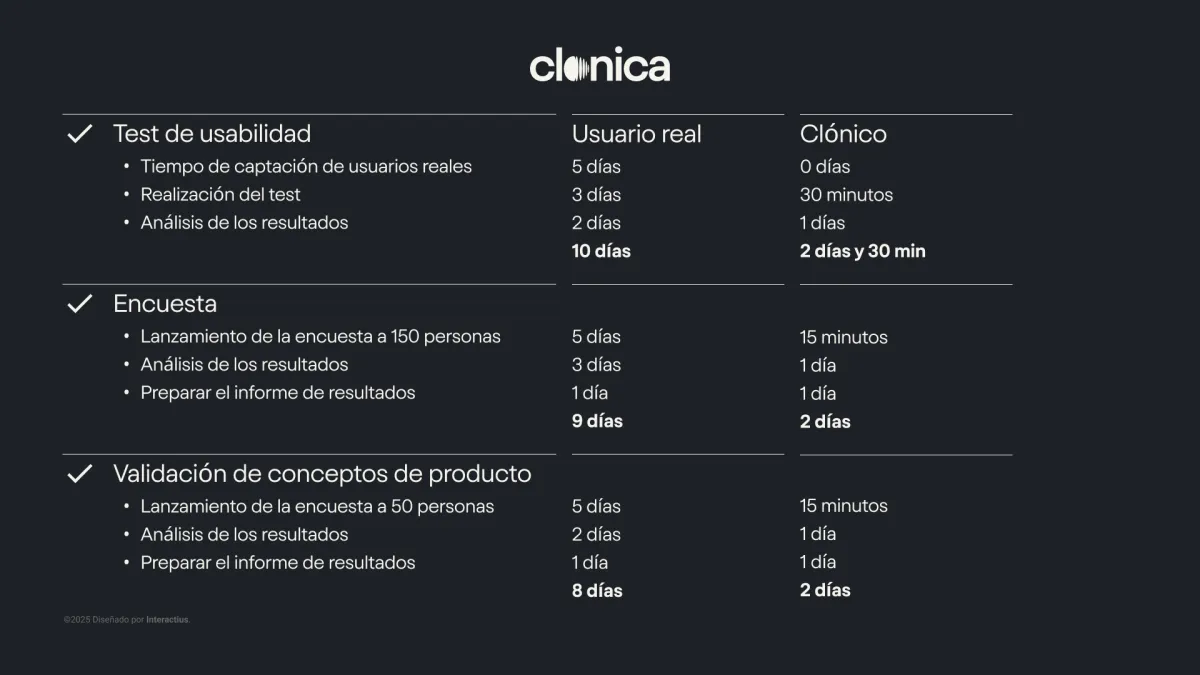
It is not about making every decision with the clónico, but about arriving better prepared for the next interaction with real users.
2. Democratising access to the user
Something I was particularly excited about was ensuring that user knowledge did not stay locked away in research or UX. With Clonica© we are seeing:
- Marketing teams testing messages and campaigns with the clónico.
- Product managers validating flows or features before prioritising them.
- UX writers refining tone and copy based on how the synthetic user responds.
- Business stakeholders stress-testing pricing or sales arguments.
Instead of sending an 80-slide deck, I can now say: "Talk to Blanca. Ask her yourself." And often the clónico dismantles ideas in two responses, because it responds as the real segment we already studied would.
3. New ways of working together
Another interesting consequence is how it changes the dynamics of workshops and sessions:
- We bring the clónico in as a "ghost participant" in ideation workshops.
- We ask the clónico to argue why it prefers option A over option B.
- We map complete journeys by talking to it step by step.
- We test content and campaigns before launching them.
Suddenly, the user — even if synthetic — has a voice in the room almost every day.
How many clónicos do I need and how long do they last?
This is one of the questions we are asked most. The honest answer is: it depends.
In large organisations we usually create specific clónicos aligned with their key segments.
In parallel we are building our own panel of clónicos so that smaller companies, studios, or freelancers can test with synthetic users without having to kick off a large research project.
On longevity, it also varies:
- There are relatively stable segments where a clónico can be useful for several years.
- In fast-changing contexts we prefer to refresh it every few months, with new qualitative research or contrast surveys.
What I take away from all of this (4 key learnings)
If I had to sum up what I have learned working on Clonica.io, I would say:
1. AI does not replace research: it amplifies it.
A synthetic user is only as good as the research behind it. If you build it on thin air, you will have thin air with a voice.
2. Context matters more than demographics.
What makes the difference is not age or postcode, but fears, contradictions, support networks, the real language people use.
3. Product culture changes.
When the whole organisation can talk to the user, it is no longer "what the UX report says", but "what Blanca told me yesterday". That reduces friction and aligns decisions.
4. Speed is only an advantage if you maintain your judgement.
Reducing processes from 10 days to 2 is fine, but only if you know which decisions you can make with a clónico… and which ones require going back into the field with real people.
If all of this resonates with you and you want to see how it plays out in a real demo, I invite you to watch the full video of the presentation on our YouTube channel.
There you will be able to see how we work with these synthetic users live, and the questions we were asked during the session.
If you would like to find out more about Clonica© and how synthetic users can benefit your research and design, contact us.