
Discover how synthetic users can transform product design, keeping human empathy at the heart of AI-driven research.
In an era where Artificial Intelligence promises to solve everything — creating, thinking, deciding — it is tempting to forget where the truly transformative power lies: in our human capacity to empathise, understand and connect.
Today we are building synthetic users, based on models that simulate real needs and behaviours. Yet the truth is simple: no model, however sophisticated, can capture the essence of a human being unless it starts from prior work that is crafted and deeply empathetic.
The synthetic user is not born from code. It is born from conversation, from attentive observation, from understanding fears, motivations, dreams and contradictions. It is born from seeing people not as data points, but as living stories.
How do we understand and create synthetic users?
A synthetic user is a digital representation of a real human profile, created from data obtained through primary research techniques such as in-depth interviews, contextual observation and analysis of needs and emotions. Unlike a static "persona" in a PowerPoint deck, the synthetic user can interact, offer opinions and evolve alongside the project.
The formula that guarantees their effectiveness
- High-quality qualitative research: The foundation of a good synthetic user is a deep, empathetic understanding of the real user. Demographic data or quick surveys are not enough; we are talking about in-depth interviews that explore fears, motivations, limitations and dreams. Context is key.
- Precise contextualisation: The user must be built within the real environment for which the product is being designed. If the product is intended for elderly people living alone who need assistance in emergencies, the synthetic user must reflect those realities — not merely age or physical condition.
- Theoretical saturation: Using 20 participants allows us to reach "theoretical saturation": the point at which new interviews no longer yield substantially different information. This ensures that the synthetic model reflects the diversity of relevant experiences without incurring redundancy.
- Intelligent integration of AI: Although AI cannot (yet) replicate the human empathy required for qualitative exploration, it excels at modelling, expanding and acting as the constructed profiles. AI draws on the rich data from interviews and complements it with its knowledge of global patterns, giving rise to synthetic users that are realistic, responsive and always available.
Case study: Montserrat and the Apple Watch
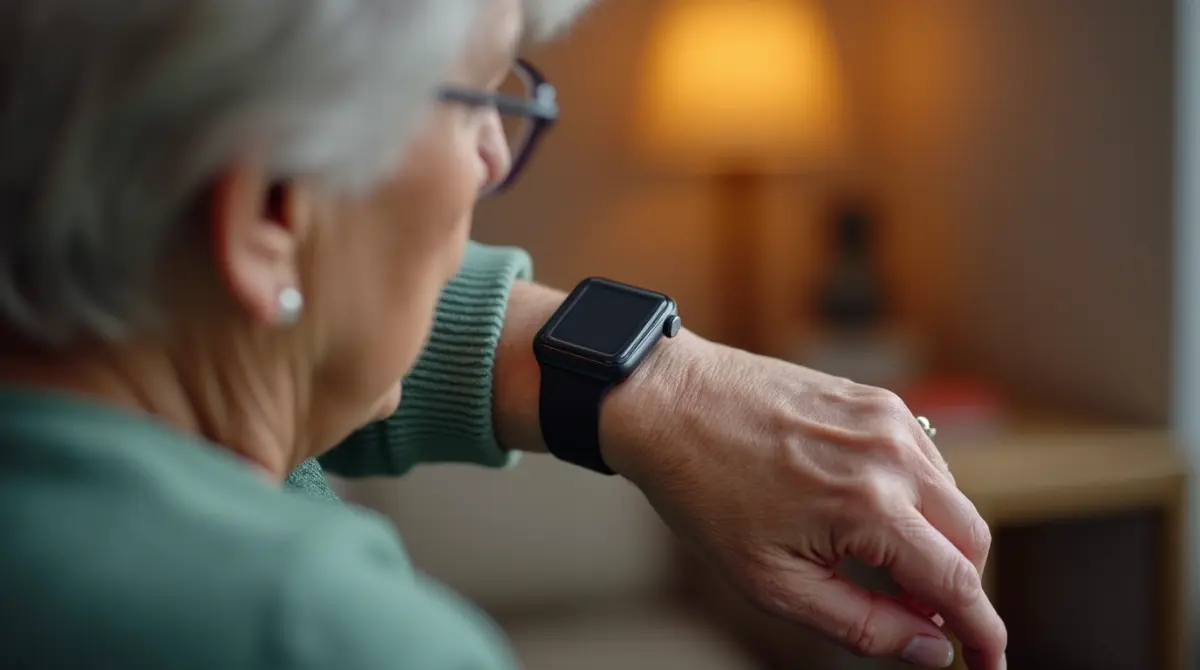
During a screen design test for an assistance service on Apple Watch aimed at elderly users, "Montserrat" was created — a synthetic user based on 20 in-depth interviews. When evaluating the design, Montserrat "commented":
- Using a watch with these screens would make me feel a little overwhelmed. Not because I don't more or less understand what each thing is, but because it feels like trying to fit an entire mobile phone into a tiny thing you wear on your wrist.
- The call screen seems practical to me, because sometimes you don't hear your phone in your bag and the watch can alert you. That would make me feel at ease, especially if my daughter is calling.
- The weather screen I do like. It's simple, clear, and that would make me feel looked after, because knowing whether it's going to be sunny or cold helps me organise myself without any fuss.
- The menu screen overwhelms me. So many little icons and numbers in red would make me feel stressed and clumsy, as if I'm in a rush or have left things undone.
- The profile screen, honestly, I don't see the point of it for me. It would make me feel out of place. I don't need to see profiles or statistics of anyone, least of all on such a tiny screen."
This precise, contextualised feedback made it possible to implement key improvements before the product launch.
Benefits of working with synthetic users
- Agility: They allow you to test iterations at any time.
- Depth: They retain the emotional and contextual richness of the real user.
- Scalability: They simulate multiple usage scenarios.
- Constant empathy: They keep the "why" behind every decision alive.
Humanity before technology
If we only feed the AI with cold data or superficial inputs, we will end up with disconnected synthetic users.
But if we invest time in truly understanding — in capturing emotions, needs and contexts — AI can become a powerful ally.
The real formula is not found in silicon. It is found in skin, in voice and in the eyes.
What we do not sow with human empathy, no algorithm will be able to recover afterwards.
Synthetic User-as-a-Service is not just a futuristic trend. It is a new way of designing with AI that keeps the human focus at the forefront at all times. It means researching before you research.
With User Research powered by Synthetic User-as-a-Service, you work with synthetic users generated from real data. These profiles, built from deep qualitative interviews, are ready to take part in surveys, test flows or simulate scenarios — always aligned with the context of the product you are developing.
Because designing well does not always mean having more data, but having the right data at the right moment.
At Interactius, we are already helping teams explore this innovative methodology.
Ready to be part of the change?