

How strategic foresight helps us anticipate possible futures in order to make better decisions in the present.
At the risk of disappointing anyone who arrived here looking for a crystal ball, I think it's only fair to be upfront from the start: this is not about predicting the future. It is about systems thinking, narratives, artefacts and strategy, and, in my view, about activism and intention to inhabit plausible and preferable futures designed from the present. Yes, I am a romantic — but then again, what is the present if not the only place from which anything can be changed?
In the spirit of continuing to grow and share knowledge about this discipline, which is taking up more and more of our work at Interactius, last week we invited Jorge Camacho to join us for a conversation — one of those people who makes you feel that anticipating the future is not an option, but a responsibility. Time slipped through our fingers, but it left a rich sediment of reflections and learnings that we didn't want to keep to ourselves. Thank you for your generosity, Jorge.
A brief bio on Jorge Camacho
Jorge is a strategic designer and futurist specialising in futures thinking. He combines his academic work as Director of the Master's in Design, Methods and Explorations at Centro (Mexico City) with his role as an affiliated researcher at the Institute for the Future, an organisation with over 55 years of history based in Palo Alto, California. He is co-founder of Diagonal Estudio, a research, design and futures consultancy, and is part of the Territorios Futuros initiative, focused on systems thinking for social impact. His work unfolds at the intersection of strategic foresight, innovation and social change.
Foresight: a human superpower that can be trained
How would you explain foresight to someone who has never heard of the discipline? I put this question as the opening thread of the conversation, and Jorge's answer was revealing in its simplicity:
When this individual capacity is formalised and applied to organisations, it expands across three dimensions:
- The time horizon (from days to decades)
- The scale of action (from the individual to the sectoral or national level)
- The degree of change that can be anticipated and managed
Foresight has an orientation towards action: imagining possibilities not as an end in itself, but in service of concrete decisions in the present. And this is where two key concepts come into play:
Intentionality — the will to inhabit preferable futures — and agency — the capacity to actively intervene in their construction.
A history that begins much earlier than we think
Looking back at the origins of the discipline, the first surprise was chronological. Foresight was not born in Silicon Valley in the 1990s. Its roots stretch back to the mid-eighteenth century.
As Jorge explained, it was during the first Industrial Revolution that what he calls "the imagination of the future" began to emerge in Europe, placing that symbolic starting point in 1771, with what many consider the first futurist novel: The Year 2440, by the Frenchman Louis-Sébastien Mercier.
But the real formalisation of the discipline came in the post-war period, from the 1950s onwards, when organisations and governments began developing explicit techniques for imagining alternative futures, working with scenarios and anticipating structural change. Since then, foresight has gone through several "waves" of social interest, with the most recent — and the one most closely tied to strategic design — being the one we have been living through over the past 10 to 15 years.
Why now? The pandemic acted as a trigger, but Jorge points to something more structural: we live in a moment of polycrisis — a term that describes the simultaneous accumulation of interconnected crises — where high uncertainty makes the need to anticipate genuinely urgent. With an interesting paradox: the very context of chaos that drives interest in foresight also complicates the practice of it.
Reflections:
- The current interest in foresight is not a passing trend: it responds to a structural need generated by the sustained increase in global complexity and uncertainty.
- Knowing the history of the discipline helps to anchor its practice in a solid tradition and to avoid reinventing the wheel.
Administration, strategic planning and foresight: three bubbles, three logics
One of the most practical questions in the conversation was precisely the one that generates the most confusion in day-to-day team life: how does foresight differ from strategic design? To answer it, Jorge drew on a diagram he also uses in his classes: three bubbles in a three-dimensional space defined by time horizon, degree of participation and the magnitude of decisions.
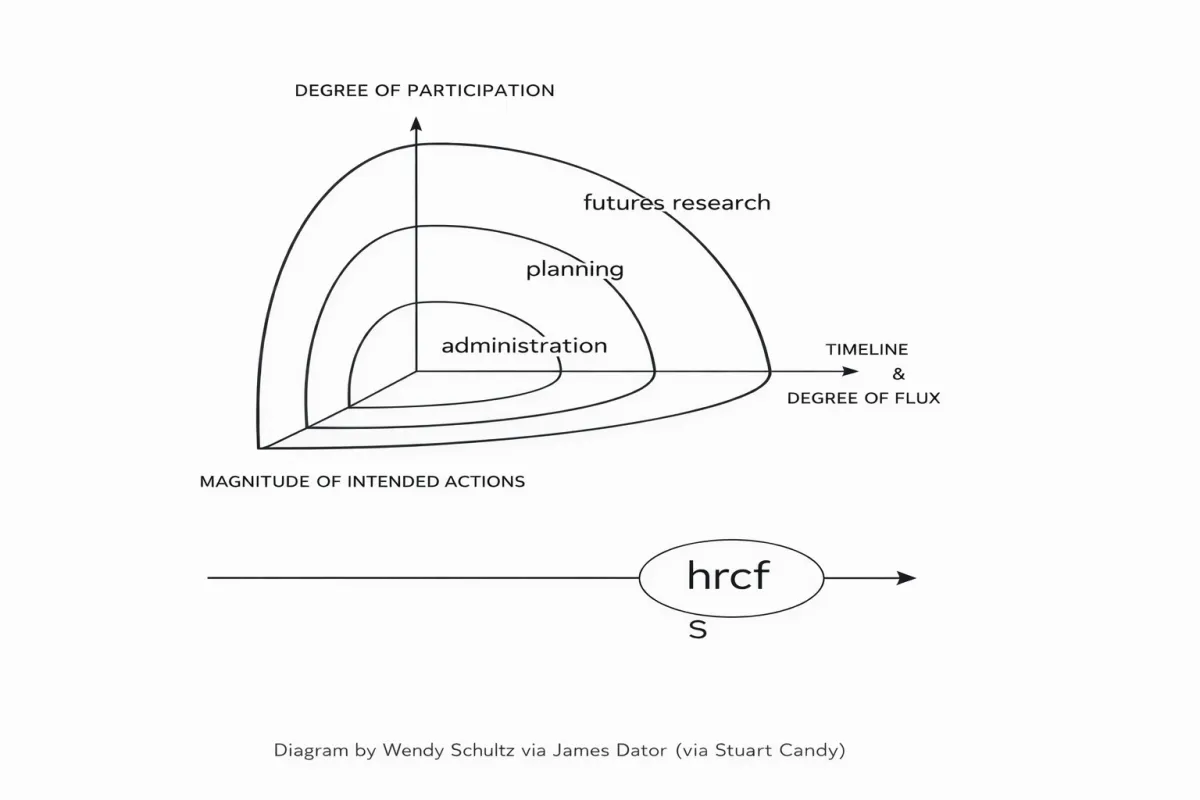
Relationship between the future, planning and administration (by Wendy Schultz)
The first bubble, the smallest, corresponds to administration or short-term management: operated by small teams, centred on routine decisions.
The second bubble, strategic planning, expands across all three dimensions: annual horizons, participation from leaders across different areas, and decisions of greater significance (opening or closing business lines, for example).
The third bubble is futures research: horizons of 10 to 20 years, participation that can involve an entire industry or sector, and decisions of great magnitude.
Applied to design, the framework translates into executional design (equivalent to management), strategic design (planning) and futures design or Design Futures (futures research). This last one combines the tools of design with the logic and methods of foresight.
Reflections:
- Strategic design and futures design are not competitors: they are complementary layers. Foresight extends the horizon of strategic design without replacing it.
- Identifying which bubble your organisation typically operates in is the first step towards understanding what foresight capabilities it needs to develop.
How do we justify the value of foresight to those who manage budgets?
Jorge's answer was both honest and strategically astute: the most important indicator is not a foresight KPI in itself, but an organisational decision that is different. If, after the foresight exercise, the organisation continues doing exactly what it was doing before, the exercise was not successful.
On this point, he mentioned the work of German researcher René Rohrbeck and his concept of foresight maturity. A maturity model for assessing how prepared a company is to respond to disruptive external change, based on data from 107 interviews with board members, corporate strategists, innovation directors and corporate foresight practitioners, with case studies at multinationals such as Siemens, Volkswagen, General Electric, Philips and Deutsche Telekom.
Reflections:
- There is no need to create an ad hoc measurement system for foresight: the indicators your organisation already uses to measure success (sales, innovations launched, market positioning) are valid for evaluating foresight impact.
- Foresight maturity is a useful concept for facilitating internal conversations about investment in foresight.
Real projects: from Ikea to AT&T, via Constellation Brands
We reviewed three real projects to bring the applicability of foresight down to earth.
The first was a project for Space 10, Ikea's innovation lab based in Copenhagen, focused on everyday safety for women in the domestic context in Mexico. The methodology combined deep ethnographic research (mental models, needs and aspirations) with a parallel Horizon Scanning process (a technique for systematically tracking signals of change across different domains) to identify design opportunities at the intersection of future trends and current needs. The result: a range of concepts spanning from household products to social innovation proposals centred on neighbourhood networks.
The second was with Constellation Brands Mexico, the local subsidiary of the American company that distributes brands such as Corona and Modelo in the United States. The brief here was to develop anticipatory innovation for the North American market: more focused on trend analysis and scenario planning than on current needs, and with the distinctive feature that concepts were materialised directly into laboratory experiments thanks to the company's R&D infrastructure.
The third, currently ongoing, is with AT&T México: a project named 2034, which began in 2024 with the goal of imagining how the customer experience in Mexico's mobile telephony industry might evolve. What began as an exploration of 10-year scenarios has evolved into a continuous two-year process that combines a vision of the future with deep analysis of the present, and is building the organisation's internal foresight capability in a sustained way.
Reflections:
- The most effective foresight projects always combine two simultaneous probes: research into the present (ethnography, needs) and research into the future (signals, trends, scenarios).
- Foresight as sustained accompaniment, rather than a one-off project, is what enables genuine foresight maturity to develop within an organisation.
AI and foresight — how do they coexist?
Jorge adopted a critical but pragmatic stance. Large language models (LLMs) — the ones behind tools like ChatGPT or Claude — have for some time been particularly useful for tasks central to foresight: systematising signals, synthesising trends, drafting scenarios or generating forecasts. But there is a growing challenge: AI can produce in minutes what used to take weeks. That raises the bar for what the human futurist must contribute.
The distinctive value of human work in foresight shifts, therefore, towards the opening and closing moments of the process: defining the problem with the organisation, interpreting the scenarios within their specific context, and translating all of it into concrete decisions and actions.
On the future of foresight, Jorge suggests that, as happened with Design Thinking, the hype will pass — and that will not be a bad thing. What will remain is foresight as a normalised practice, accepted as part of the standard functioning of any organisation with vision. And alongside that, a necessary evolution: a closer dialogue with the sciences of complexity, systems thinking and chaos theory.
Reflections:
- AI does not replace foresight: it frees up time for the part that carries the most value, which is the conversation with organisations about what to do with the scenarios produced.
- The future of foresight lies not in its popularisation, but in its normalisation as a foundational organisational practice.
And as a closing note, Jorge offered us two headlines we might see in newspapers in 2035 that give plenty of food for thought:
The optimistic one: the world achieves a 50% reduction in greenhouse gas emissions relative to 2019, moving closer to the Paris Agreements.
The pessimistic one: a 50% loss of jobs globally due to the effect of artificial intelligence — a topic that, in his words, is fundamentally about a class struggle.
A recommendation: the book The Field Guide to Design Futures, edited by Giovanni Caruso and Silvio Lorusso, can be downloaded or purchased in print at designfutures.guide.
Thank you to Jorge Camacho for his time and his ability to bring a complex discipline down to earth through concrete examples, honesty about its limitations and great conceptual rigour. This conversation is only a first chapter: there are several topics — such as futures prototyping, narrative, and the ethics of foresight, among others — that undoubtedly deserve their own space. We will come back to you.
If you'd like to explore the full conversation, you can watch the complete video here or, if you fancy a chat about the topic, we would be delighted to invite you for a coffee.
"The future is not what is coming. It is what we decide to do today with everything we know."