

What happens when you are the user yourself? How a personal need can become a collective opportunity for innovation.
In the world of design and digital innovation, we often talk about the importance of putting the user at the centre. But what happens when that centre is yourself — confronted with invisible barriers, incomprehensible processes, and a system that was never designed with you in mind? The story of Entre Trámites invites us to look beyond archetypes and tools: it challenges us to design from lived experience, from personal pain transformed into collective opportunity.
We spoke with Javiera Papic, Co-founder & Partnerships Manager at Entre Trámites — a Chilean entrepreneur based in Spain who turned her personal experience navigating bureaucracy as a foreigner into an opportunity for social innovation. Her approach combines empathy, active listening, and collaboration to create more accessible, human-centred services.
"We, as foreigners and entrepreneurs, had seen a huge market need […] you don't understand what you need to do. And faced with that need, we said: let's be a source of information first and help these people."
From frustration to discovery: the power of the "lived problem"
Javiera Papic and her team did not initially set out to build a solution for bureaucratic processes in Spain. Their first project — a platform for renting spaces in state schools — collapsed with the arrival of COVID. But from that failure emerged another need, one far more immediate and tangible: the uncertainty faced by foreigners navigating a legal and administrative system full of barriers. A need they knew first-hand.
"We started with a YouTube channel informing people how to complete their paperwork […]. People started asking us to handle the processes for them, and eventually it was: right, let's try it out without really knowing what we're doing."
The product discovery began when they stopped thinking like founders and started acting as expert users. The spark of innovation came from staying alert to market signals and being willing to iterate from mistakes.
Service design as an act of empathy
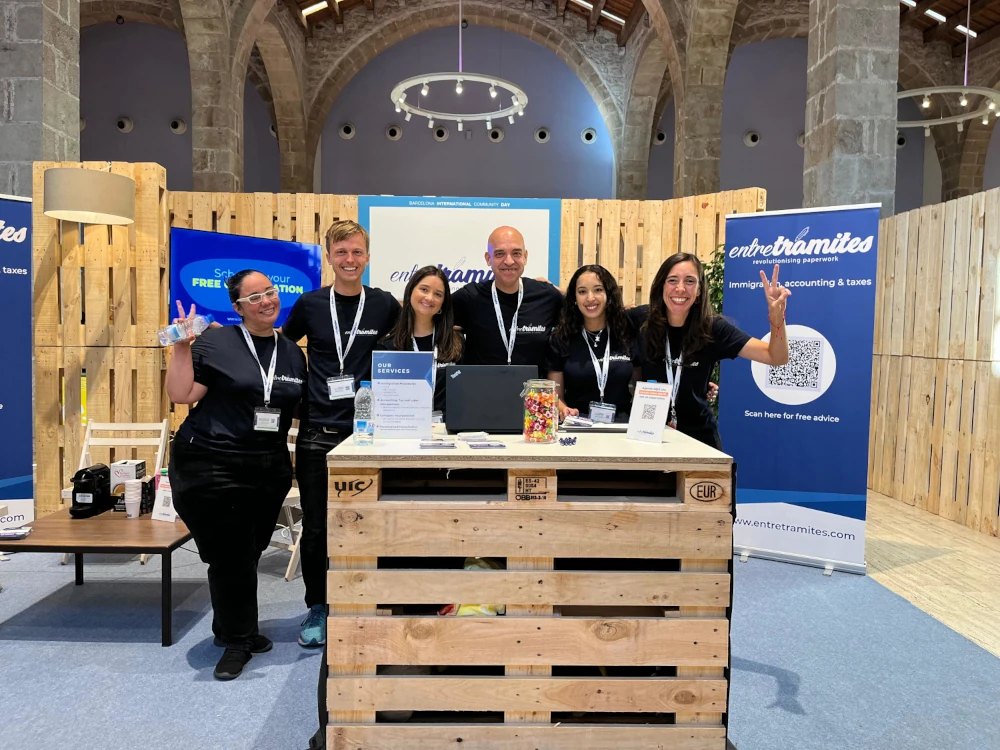
Entre Trámites is not defined solely by offering online administrative services. Its value lies in the experience it delivers: clarity, guidance, language accessibility, and anticipation. A holistic vision rooted in a deep understanding of the user's situation.
"We wanted to build a one-stop shop […]. I need someone to help me with taxes, but also with my visa and my employment situation. People don't want to face this alone."
From a human-centred design perspective, their approach breaks down silos. Designing for this type of service means thinking about transitions, fears, and complex decisions — it means designing for life moments.
Validating means listening (genuinely)
One of the most revealing moments was the initial difficulty in winning over the local market. Surveys suggested dissatisfaction, yet few were willing to switch their gestoría.
"People said they weren't happy with their advisor, but when asked whether they'd switch, the answer was: 'no thanks, I'll stick with mine'. The switching costs are quite high."
That early validation failure was not an obstacle — it was a learning opportunity. It led them to refocus their attention on foreigners, young people, and digital professionals. They validated through observation and closeness, not through theoretical hypotheses.
"What has allowed us to grow so quickly is that we stay alert to market signals."
A culture of collaboration as a design strategy
Entre Trámites' expansion has been anchored in its ability to build partnerships. Universities, coworking spaces, hubs, and public bodies are now among their partners.
"We approached universities when we were very small. They'd say: I like it, but I'm not quite convinced yet. So we said: let's offer webinars, content, let's simplify their processes."
From a service design perspective, this strategy not only facilitates customer acquisition — it also improves the experience. Collaboration is not just about gaining clients; it is about strengthening communities.
"Today we work with more than 250 institutions. It's not that the client is necessarily looking for you — it's that we're present when the need arises."
3 Powerful lessons:
- The deepest innovation happens when we solve a problem we understand from the inside out.
"I've had the entrepreneurial bug since I was born […] When you live it yourself, you make so many mistakes through lack of information. That's when it hit us: look, there's a niche here."
- Service design must consider the user's complete journey, not just the point of contact.
"Many times a client comes to us for a visa, but then they need help with taxes, with becoming self-employed, with hiring staff. You have to support the entire journey."
- Validating is not about asking questions — it is about listening, adapting, and co-creating with the market.
"Our own clients started requesting new services. We kept expanding because they kept telling us what they needed."
The story of Entre Trámites is not just that of a startup that found the right niche. It is a lesson in how genuine empathy, active listening, and a willingness to explore the unknown can become a powerful engine for design and innovation.
"If you truly believe in what you're doing, don't be afraid to follow up again, to adapt, to keep trying."
In a world that so often prioritises speed, minimum viable products, and conversion metrics, it is worth remembering that, in the end, we design for people. And that the best solutions emerge not just when we talk to them, but when we decide to become one of them.
Visit the Entre Trámites website: https://entretramites.com/
We leave you here with the full interview.