

In a fragile, uncertain world, at Interactius we decided to stop and look at ourselves. This is how we experienced our rebranding: uncomfortable questions, ambiguity and critical thinking.
The rules that worked yesterday guarantee nothing today.
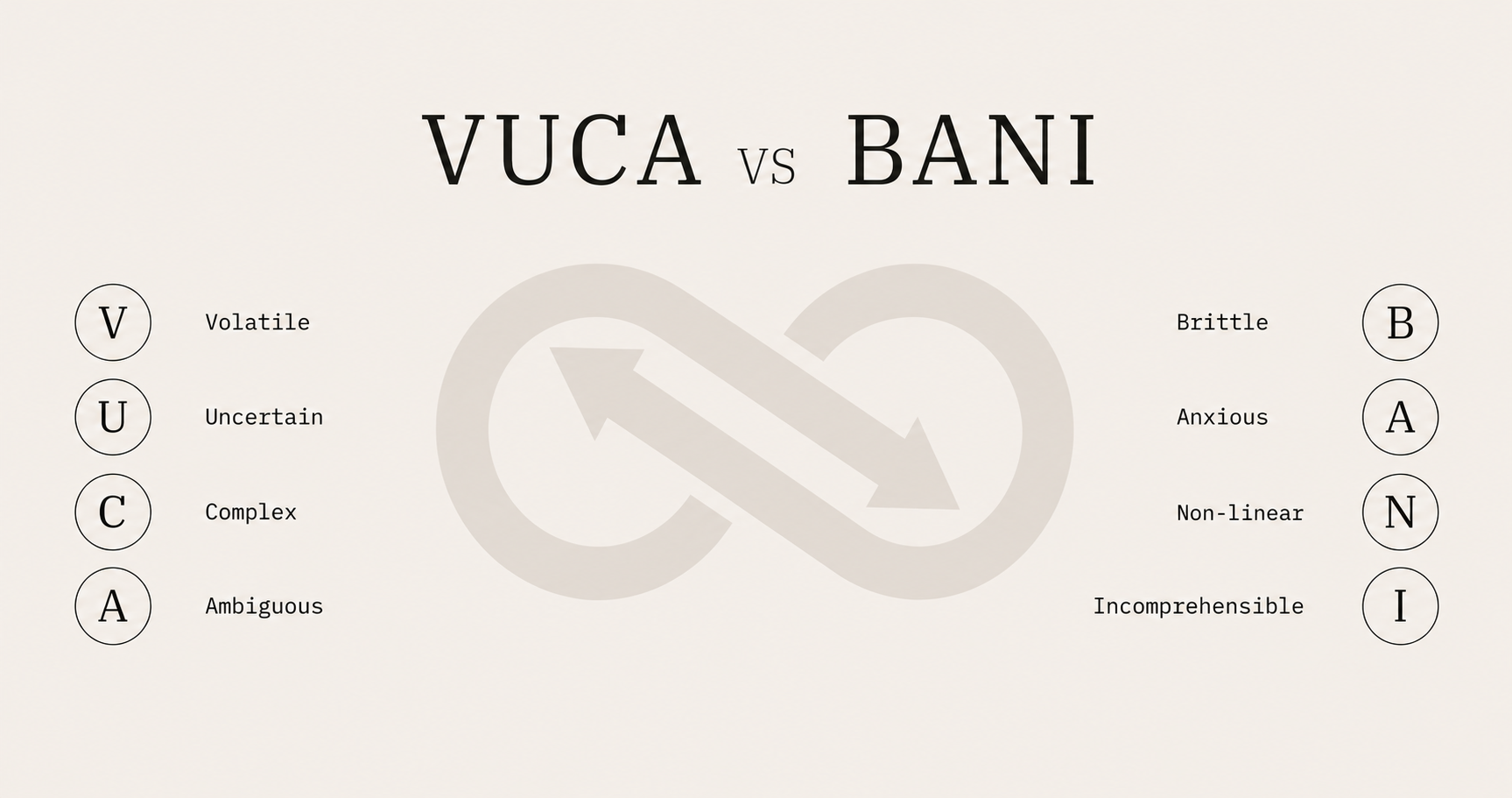
For decades, the VUCA model (volatile, uncertain, complex, ambiguous) was the framework organisations used to name turbulence — and it served us well. It accurately described a world changing faster than it could be planned for, and gave leadership teams a shared vocabulary for making decisions under uncertainty.
But VUCA fell short.
In 2020, futurist Jamais Cascio proposed a new framework for the moment we were living through: BANI (Brittle, Anxious, Non-linear, Incomprehensible). This is not a semantic update — it is a qualitative leap in how we understand complexity.
Where VUCA described the difficulty of operating in turbulent environments, BANI describes something deeper: the sense that the very tools we use to make sense of the world have stopped working.
Each dimension reveals a distinct fracture:
- Brittleness reminds us that systems that appeared solid can collapse unexpectedly.
- Anxiety paralyses decision-making because no option feels sufficiently safe.
- Non-linearity breaks down the cause-and-effect logic underpinning most management models.
- Incomprehensibility confronts us with situations where even the most rigorous analysis produces no certainty. It is not that data is lacking. It is that data alone no longer suffices.
What does this mean for organisations?
The management logic that worked in VUCA environments — planning with clear horizons, building stable competitive advantages, communicating from fixed positions — proves inadequate when the ground shifts in a non-linear way. Organisations that continue applying methodologies designed for stable environments find themselves permanently in reactive mode, struggling to maintain stability while the context demands radically different capabilities.
The problem is no longer just the speed of change. It is that change has stopped being predictable in its form or its consequences.
Brands are no exception to this logic — in fact, they are one of its most revealing territories. Because a brand is not only what an organisation communicates; it is the way an organisation tells the world where it thinks from and what it works for. And when those decisions were made in a different historical moment and no one has questioned them since, identity becomes inertia. And inertia, in a BANI world, is not neutral — it is a form of drift. The symptoms are familiar: projects that arrive and don't fit, difficulty explaining in a few words what you actually do, the feeling that the market sees you in a way that no longer represents you.
That was exactly what happened to us.
We had spent more than ten years building projects, methodologies, a team and a reputation. And at some point along the way, without anyone consciously deciding it, we had stopped evolving the brand at the same pace as our way of working was evolving.
For years, rock music as a creative territory had given us a language: energy, disruption, authenticity. It was genuine. But we were so faithful to that image that we didn't notice when it had stopped growing with Interactius. The brand was telling a story that was no longer ours. Recognising that was the first step. It was time to stop, look, and start from a more truthful place.
The process. Deciding what we are and what we are not

Phase 1. Direction: where we are and where we want to go
Every process begins by asking the right questions. Not the comfortable ones, but the necessary ones. Richard Rumelt details this in his book Good Strategy Bad Strategy: most of what organisations call strategy is nothing more than a wish list without any real diagnosis. And without an honest diagnosis, everything that follows is decoration.
We carried out a thorough diagnosis combining two perspectives. One outward-facing, analysing the market, trends and competition. One inward-facing, evaluating the state of the system, our current positioning and client perceptions.
The next step was to translate everything we had learned into direction: our strategic pillars, which help us define where and how we wanted to play. A strategic pillar is not a business area or a service — it is a territory where an organisation decides to concentrate its energy because that is where it can create differential value in a sustainable way. And from each pillar hang concrete strategic decisions: what we do, what we decline, how we prioritise. Internal decisions, firm and non-negotiable.
Those pillars became the guide for redesigning our services: Strategic Thinking, Experience Design and Cultural Transformation. Three territories in which to concentrate our energy. Three ways of creating value that already existed within our expertise but now had a name and clear boundaries.
And with the services defined came more questions: for whom, exactly? Does this offering meet their needs? Have they changed too? We redefined our buyer personas and tested the fit with them. We iterated, of course. No strategy survives intact its first contact with reality.
Phase 2. Identity: who we are and how we tell it
If the direction phase answers the question of where we play, the identity phase answers: who we are when we play there. And that question demands going far beyond tone of voice or colour palette.
We redefined from the foundations. Mission, vision, values, brand principles, voice, tone, style guide, verbal identity manual. From a place of honesty. Co-created with those who have to live them — the team — so that there is coherence between behaviour, communication and culture.
Everything decided in this phase was distilled into Camila Farrés, our brand persona. Camila is the synthesis of everything Interactius has decided to be: her voice, her judgement, her attitude towards every decision. We activated her as a synthetic user on our Clonica platform: an artificial intelligence trained on Interactius's values, voice and criteria that acts as guardian of the brand. Before publishing, proposing or communicating, Camila reads. And if something doesn't fit with who we are, she says so. Not as a quality filter, but as a guardian of coherence.
Phase 3. Creativity: finding the concept that names everything
We had spent months in meetings, workshops and long conversations. At some point, someone asked the simplest question of the whole process: what is Interactius?
No two answers were the same. There was no consensus. An agency, a consultancy, a lab… That truth, which began as uncomfortable, turned out to be the most revealing of all.
What seemed like a problem of internal alignment was, in reality, a clue to something deeper: we don't fit neatly into one definition or another. And we care about that. We feel at home there, in El Entre — in the spaces of transition, between states, on the thresholds where something has ceased to be what it was but is not yet what it will become.
El Entre is the space where categories blend and boundaries blur. To design in El Entre is to move towards the margins where tension exists, where things that haven't arrived yet are beginning. Where barely visible realities and hidden truths reside that the centre cannot reach.
Working there is not a comfortable position. It requires a liminal attitude — the conviction that the best answers are not at the centre, but in the margins where things are beginning to be.
We didn't have to invent anything. El Entre was not a creative decision. It was a recognition. Something that was already true. And that now had a name.
Designing in El Entre is not a theoretical exercise; it is the way we create value where judgement matters more than process.
Phase 4. Action: when strategy becomes discernment
A strategy that is never activated does not exist. But activation without strategic grounding is just noise. The challenge of this phase was not to produce — it was to translate. To convert everything thought through, debated and decided into something that could guide every design decision, every piece of communication, every proposal.
The result was five design principles. Not aesthetic norms or style rules, but criteria. The distinction matters: a norm tells you how to do something; a criterion tells you from where to think.
- Empty space carries weight. What occupies no space also decides. In a world saturated with stimuli, restraint is a stance. What we choose not to show defines as much as what we show.
- Design from the margins. The greatest biodiversity occurs in transitional zones. The richest ecosystems are not at the centre — they are at the ecotone, at the edge where two worlds meet. That is where we work.
- Movement as revelation, not animation. Things begin to be in the interval. What moves does not decorate — it shows something that could not be seen in stillness. Time as a design material.
- Form follows thought, not trend. Clarity before comfort. We do not design to be liked; we design to make something more true, more legible, more useful. Trend is an easy answer. Thought is an answer of one's own.
- The human is not illustrated, it is allowed to be seen. Research as an act of listening, analysis as an act of empathy. People are not data or archetypes — they are the origin and the destination of everything we design.
Five principles that do not describe a style. They describe an attitude.
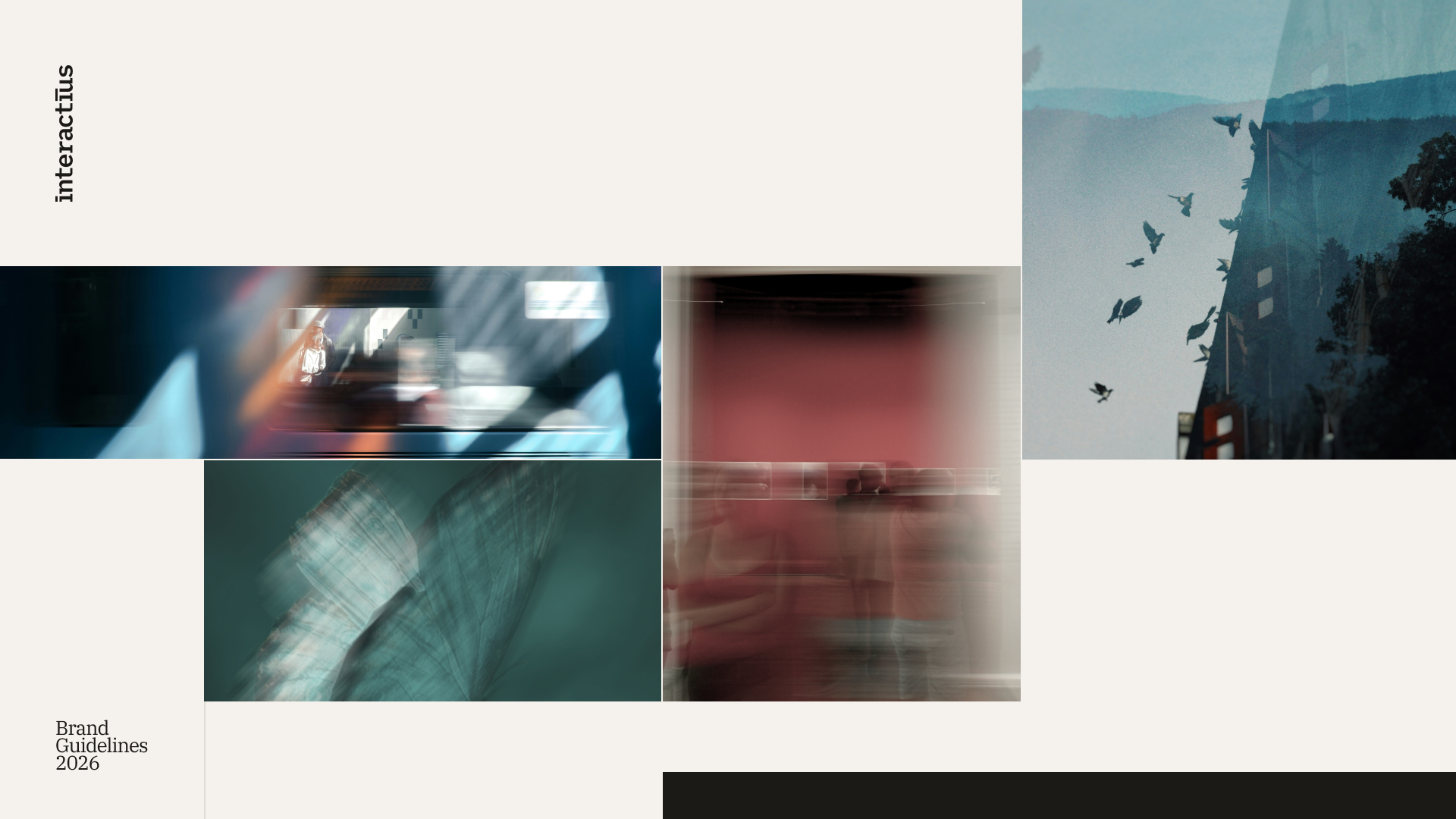
With all of this we arrived at Brandays, at Blanc Festival. Not with definitive answers, but with an honest process we wanted to share. Because we believe that showing how we think is the best way to find those who think similarly.
Perhaps the greatest competitive advantage in a BANI world is not agility or technology. It is knowing who you are. And having the honesty to build from there.