

AI agents already buy on our behalf. How the designer's role changes: Agent Experience, design systems, accessibility and judgement.
I have been designing for e-commerce for years and, like most of the industry, I have worked with my eyes on the centre. Optimise for the average user, solve the most frequent case, polish the same PDP or PLP over and over to scrape a few tenths of conversion.
That has been the foundation of UX and it has brought us this far. But the playing field is changing, and what used to work is no longer enough.
AI generates interfaces in seconds, tools automate almost everything, and a new kind of customer has appeared — one that does not look at screens: the agent. This agent searches, compares and buys on our behalf.
So the question is no longer just how to design an on-brand page that converts well… It is how to design for two users at once: one who feels and one who interprets.
My new user has no eyes: designing for AI agents
In May, Amazon launched “Alexa for Shopping” in the United States, replacing Rufus. It searches, compares, watches for deals and can buy for you when a product drops in price. With Buy for Me, it also completes purchases on other retailers' sites using your shipping and payment details. In September, Meta introduced Muse, a personal agent that does the shopping, books travel and keeps working even after you close the app — including from WhatsApp. And since January, Google has allowed purchases inside Gemini at retailers such as Walmart and Wayfair.
The fullest versions of these agents work, for now, in the United States and not much further. But it would be a mistake to think this is far away. Alexa+ has been helping people shop in many Spanish homes since April, and Meta AI is part of our WhatsApp conversations. Agents are not arriving all at once — they are arriving in layers.
The purchase is moving outside the viewport: from the brand's shop window to a conversation with an agent that decides which products people get to see at all. And that has an uncomfortable consequence for those of us designing e-commerce: the first user you have to convince may no longer be human.
For a deeper look at agentic commerce, my colleague Yolanda Delgado explains how this new buying model works — from browsing and clicking to delegating and executing — and why it forces us to design AX (Agent Experience). You can read it in Agentic e-commerce: the new AX challenge and the end of the traditional interface.
From designing experiences to designing strategy
For years, a designer's value has been measured in deliverables: wireframes, prototypes, screens and components. We designed experiences, understood people and translated what they needed into usable interfaces.
That is still the foundation of the craft, and I do not think it is going away. But if an AI can generate a decent PDP in seconds and an agent can buy without ever seeing it, UI alone is no longer enough to set us apart. An increasingly important part of the work happens earlier: deciding what needs to happen, why, and within what limits — especially when the one acting is no longer the person but their agent.
The people who adapt best to this change will not be the ones who master the most tools, helpful as that is, but the ones who know what to ask before they open them.
For me, that is moving from designing experiences to designing strategy: still shaping what we build, but also helping decide which problem is worth solving.
Where is this new mindset heading?
Two users, one shared foundation. The person delegating needs clarity, context and control. The agent needs structure, semantics and reliable data. Underneath, both are asking for the same thing: clear, honest, well-organised information. Designing that shared foundation is the most interesting challenge we have had in years.
No trust, no conversion. If I delegate a purchase, I need to know what the agent can do without asking me, how I undo a mistake and what exactly it did. Conversion still matters, but now it depends on the person trusting it enough to delegate. Permissions, limits, transparency and reversibility are new design materials.
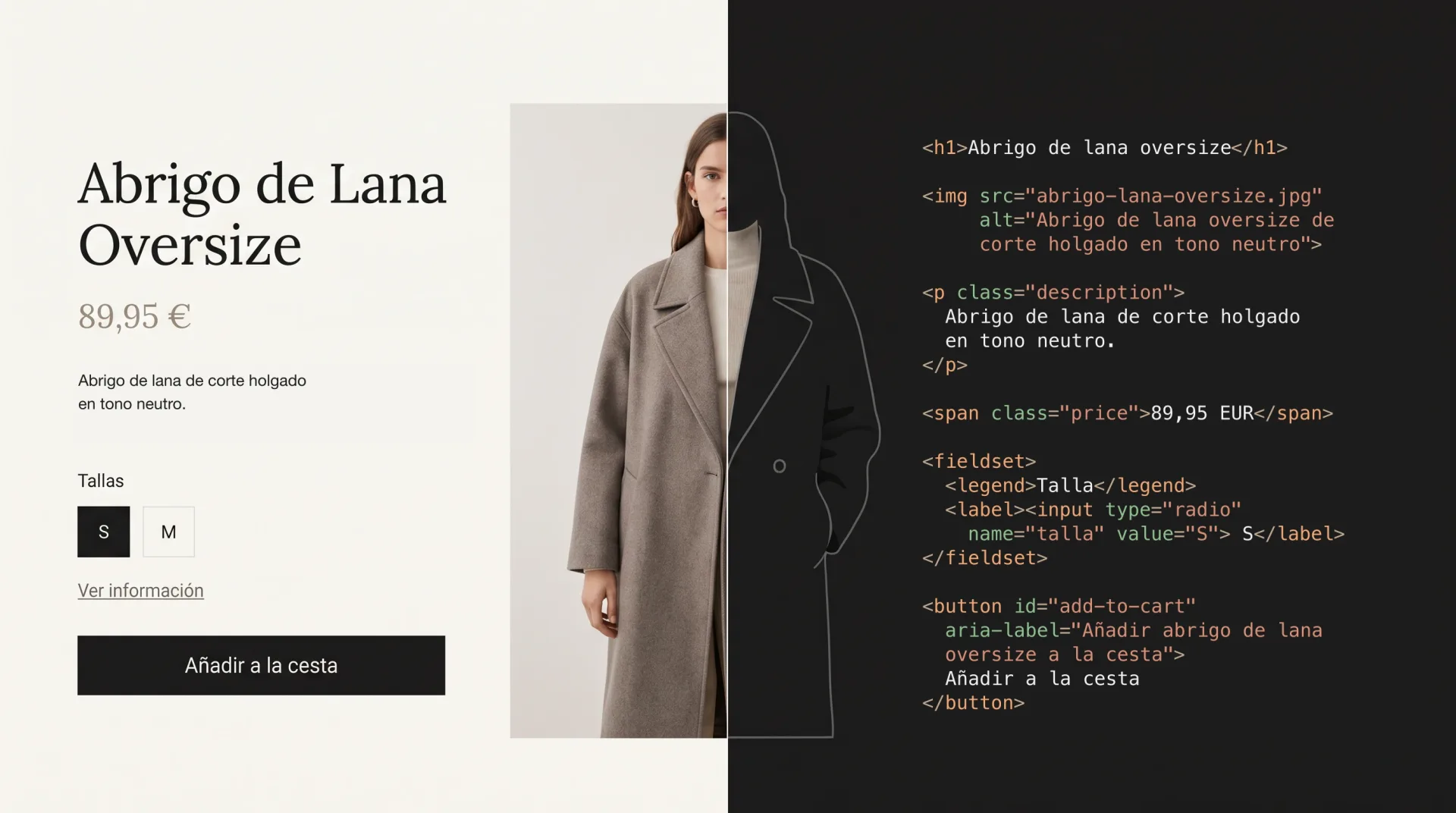
Content becomes the interface. What an agent understands about a product depends on its description, its attributes and its alternative text. What we used to leave until last now closes the sale. It is a great opportunity for UX writing, and confirmation of something we have been saying in accessibility for years: alternative text was never a minor detail.
Aesthetics are no longer the biggest differentiator. I say this as someone who loves visual design: a beautiful interface still matters when the person signs off, but it is no longer enough. The brand has to show up earlier — in the quality of the information and the trust it generates, even when nobody is looking.
What role do design systems play in the agentic era? From UI kit to brand guardrails
Their job is to teach agents how to be your brand. And for that they have to stop being a UI kit.
This one is close to home, because at Interactius we have worked with design systems for years. But let us be honest: many of the ones I have seen — including some I helped build — are in practice a UI kit, a library of components, colours and typefaces so design and development can move faster and more consistently. It worked because every screen passed through the hands of someone who knew the brand.
With agents, that changes. Brands will have their own shopping assistants, conversational interfaces and experiences generated in real time. They will speak and recommend on the brand's behalf thousands of times a day, and nobody will review every answer. So the question is simple:
Where does an agent learn to be your brand's agent?
For me, the answer is the design system — but one that has moved from component catalogue to documented judgement. It needs rails that guide, so that any experience, whoever creates it, is recognisable as the brand's, and guardrails that protect, so it never strays from what the brand is.
What your design system cannot do without in the agentic era
1. Judgement: who the brand is and what it decides
- The reasoning behind every decision. For me, the most important part. An agent can follow a rule, but it will only get a new case right if it understands what the rule is for. The same is true of people, incidentally.
- Personality, turned into behaviour. Saying the brand is approachable is not enough. You have to spell out what that means when recommending a product, answering a question or handling a complaint.
- Voice and tone per situation. A brand does not speak the same way confirming an order as it does reporting an error or admitting it does not know something.
- What the agent can do on its own. What it decides without asking, when it needs permission, and when it must hand the case to a person.
2. The technical foundation: how it is built
- Semantic tokens. Names that express intent — primary action, critical alert — not just a hex value.
- Components with usage rules and accessibility built in. From the start, not as a patch at the end.
- Patterns for when the agent acts on your behalf. How it asks permission, how it confirms a purchase, how it explains why it recommends something, and how you undo what you did not want.
3. What I almost never see, and is now essential
- Written ethical limits. These are the guardrails: what the brand will never do, such as preselecting options, manufacturing urgency or hiding information.
- A format machines can read. Structured, versioned documentation in formats like Markdown or JSON — not just beautiful pages built for us to read.
An agent without a design system improvises the brand. One with a well-documented system represents it.
And that changes our role too: those of us working on design systems move from maintaining components to looking after the brand's judgement.
Accessibility, from perpetual afterthought to leading role
If you follow me, you will know accessibility is my subject. And I have never seen it as well placed as it is now.
For years I have had to defend it in meetings as something we “had to do”, almost a legal checkbox. The curious thing is that everything that makes a product accessible — semantic HTML, a clear structure, meaningful labels, predictable flows — is almost exactly what an agent needs to understand it. Designing for someone using a screen reader, navigating by keyboard or needing plain language is, today, designing so your shop exists for agents at all.
UX has learned to design for the centre. Accessibility, by contrast, has always looked to the margins. And now, suddenly, the margins are the centre.
With the European Accessibility Act now in force, it stops being an awkward obligation and becomes a competitive advantage. On top of that, agents can be a powerful assistive technology for people with disabilities — as long as they do not create new barriers along the way.
What we still have to work out
I do not have all the answers, and I suspect nobody does yet. But these are the questions that keep coming back to me:
- How do we measure experience without clicks? Sessions and funnels as we knew them stop making sense.
- How do we avoid leaving people out? Neither those who do not use agents nor those who combine them with assistive technology can be left behind.
- How do we make conversational interfaces accessible? Voice and chat have to meet WCAG too.
- How do we keep the design system alive? Updated, governed, and readable by both people and agents.
- How do we design ethically for someone who cannot see what is happening? No dark patterns, no biases hidden in the recommendations.
- Who answers when an agent is manipulated? Current regulation was written for people.
- What do we need to learn? Strategy, structured data, conversational design, ethics — and to work far more closely with development and the business.
What AI will not be able to design
None of these questions is answered by a redesign. They all depend on something that cannot be automated: judgement.
AI can generate a thousand variants of a PDP, but it does not know which one deserves to exist. It can imitate a style, but it has no taste, because taste is choosing and giving up from a particular way of seeing the world. It can make something beautiful, but it cannot mean anything by it.
Something has been on my mind for a while: the internet has turned sad. Shops that look like the same shop with a different logo, the same neutral backgrounds, the same black buttons — especially in e-commerce. It is easy to blame AI, but the sadness started earlier. We have spent over a decade optimising for conversion and copying the patterns “that work”. We went grey all by ourselves, looking at the centre.

AI did not invent that uniformity, but it accelerates it. It learns from what exists, and what exists is that average. If we let it decide for us, every shop will end up being the same shop. That is why aesthetics stop being decoration and become a decision. Daring to use a colour that is not the mean — with good contrast, mind you — a typeface with character, or a voice that does not sound like a template, is an act of judgement today.
Taste, intent, aesthetics, irony, ethics: these are not an extra on top of design. They are its core.
At Interactius we are clear about this. It is why we have stopped being an agency that delivers screens in order to work on the architecture of decisions. What we want to leave behind on every project is shared judgement.
I do not think the e-commerce designer is about to lose relevance. I think they will be the one building trust between people, brands and agents, and the one arguing that a brand should not look like every other one. For that they have three tools: a design system that captures the brand's judgement, accessibility — which has spent its whole life looking to the margins — and their own eye and experience.
Machines can design for the centre better than anyone. The margins, the taste and the judgement are still ours.