
A chronicle of the Blanc! 2026 Ágora: some 120 people and an honest debate on AI, fees and how to explain the value of design.
Another year as accomplices to the miracle that is Blanc!. Since 2008, this festival has brought together restless minds driven by a single purpose: to design. And this year it returned to Barcelona with a proposal that asked for more than listening. It asked to become the Temple of Design, an almost religious space in which to confess, debate and connect.
Our contribution was the Ágora, a space for collective participation around three themes running through the craft today: artificial intelligence, its lights and its shadows; money and clients, from fees to winning work; and the value of design, or why we find it so hard to explain what we do. We started from one conviction: the answers to what is happening to us as a profession are not always found in a panel or a keynote, almost always in the everyday details we share when we have the right space for it.
From the survey to the temple: how the Ágora came about
On Friday 23 October, at 11:30, we opened the Ágora. Behind it lay more than five months of work in which the Interactius team, together with ADG-FAD, worked out what kind of intervention made sense within the festival's strategy: turning Blanc! into the Temple of Design and creating a frame in which to share the sector's real concerns.
We approached it the way we design any service: by understanding the real diversity of the people who would inhabit it, along with the space, the time and the festival's needs. We knew it would hold students, freelancers, salaried professionals, people running studios, and design lovers who work in other sectors.
Which is why we did not choose the themes ourselves. They came out of a survey of Blanc! participants and the ADG-FAD database on the issues that worried them most. Out of six options (AI, money and fees, career paths, the role of associations and professional bodies, ethics and sustainability, and how to explain the value of our work), the three most voted were the ones that became the circles of debate. The Ágora talked about what the sector itself asked to talk about.
To give the experience a backbone we leaned on the figure of El Diseñor, a pun on diseñador (designer) and señor (lord), the character who had carried all of this year's Blanc! branding across social media since his first appearance. He has no form because he inhabits them all: he listens to you, he understands you, and he hands out penance. He is a deity, the lord of all things designed, and no creative sin can shock him. His irreverent, streetwise tone caught the audience and drew them into the atmosphere the festival was after.
It was him who opened and closed the Ágora. There was no host and no institutional welcome. El Diseñor took the floor, explained the rules of the circles and, finally, gave the room back the reflections it had shared, transformed into a sermon. That was the great coup de théâtre.
How the Ágora worked
The Ágora brought together some 120 people and became the largest session we have facilitated as Interactius. The space was split into three circles running at once, each with its theme, its liturgy and about forty people seated around it. Every forty minutes the room got moving: attendees switched circles the way you might walk the chapels of a temple, so that in two hours each person could pass through all three. That pilgrimage was the whole experience.
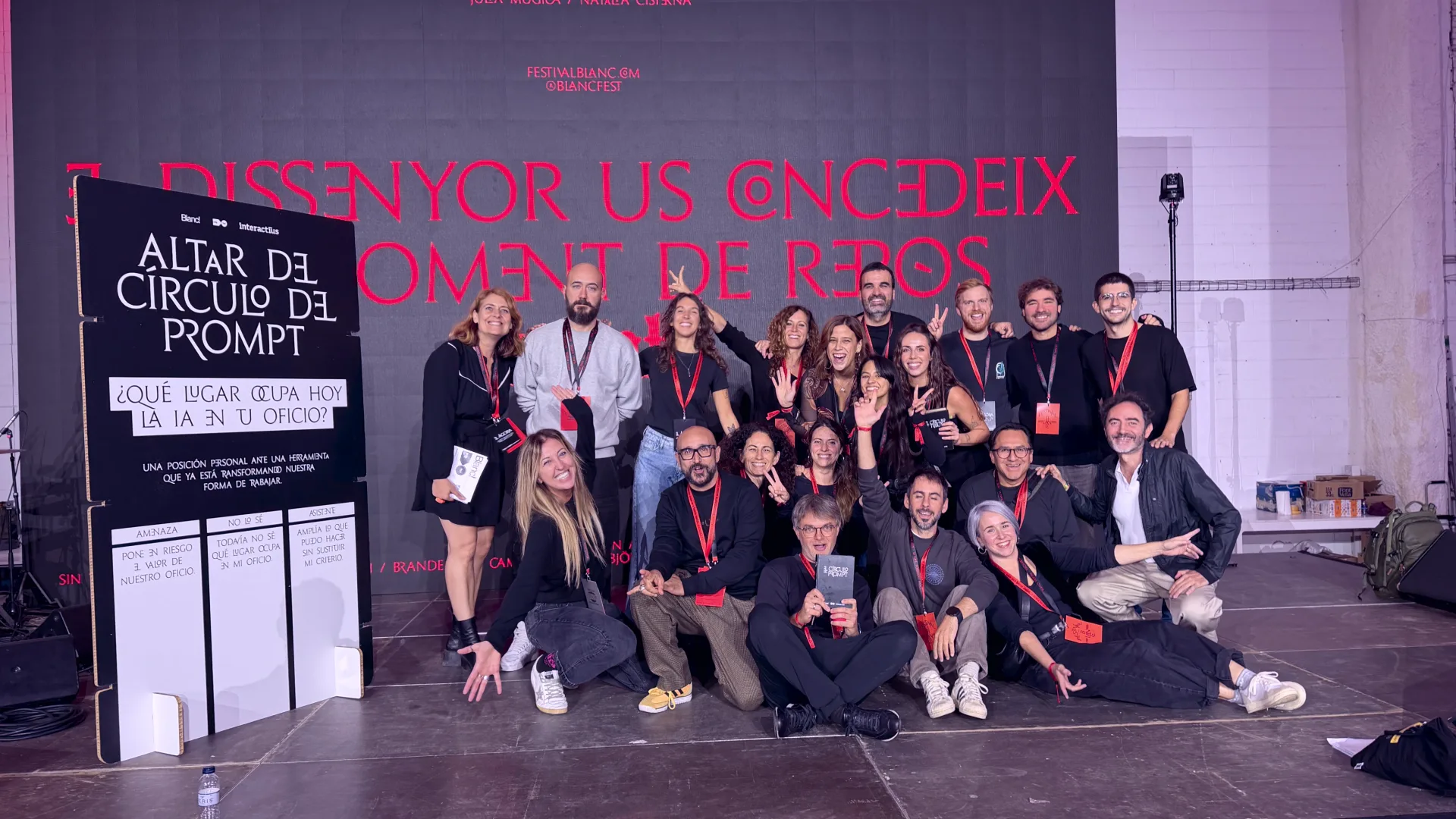
Each circle opened with a short intervention from an ADG-FAD member introducing the big theme. Within the circles, the altar invited people to place a candle beside the option they identified with most: a way of taking a position and making the state of the room visible.
In each circle, too, someone from our team acted as an infiltrator. Their role went beyond taking notes: they relayed the state of the circle to El Diseñor in real time so that he could follow the conversations as they happened, keeping anonymous everyone who spoke up. Thanks to that invisible thread, the closing sermon did not arrive written in advance: it answered what the room had just said. What follows also comes from those notes.
The Circle of the Prompt: votes and confessions
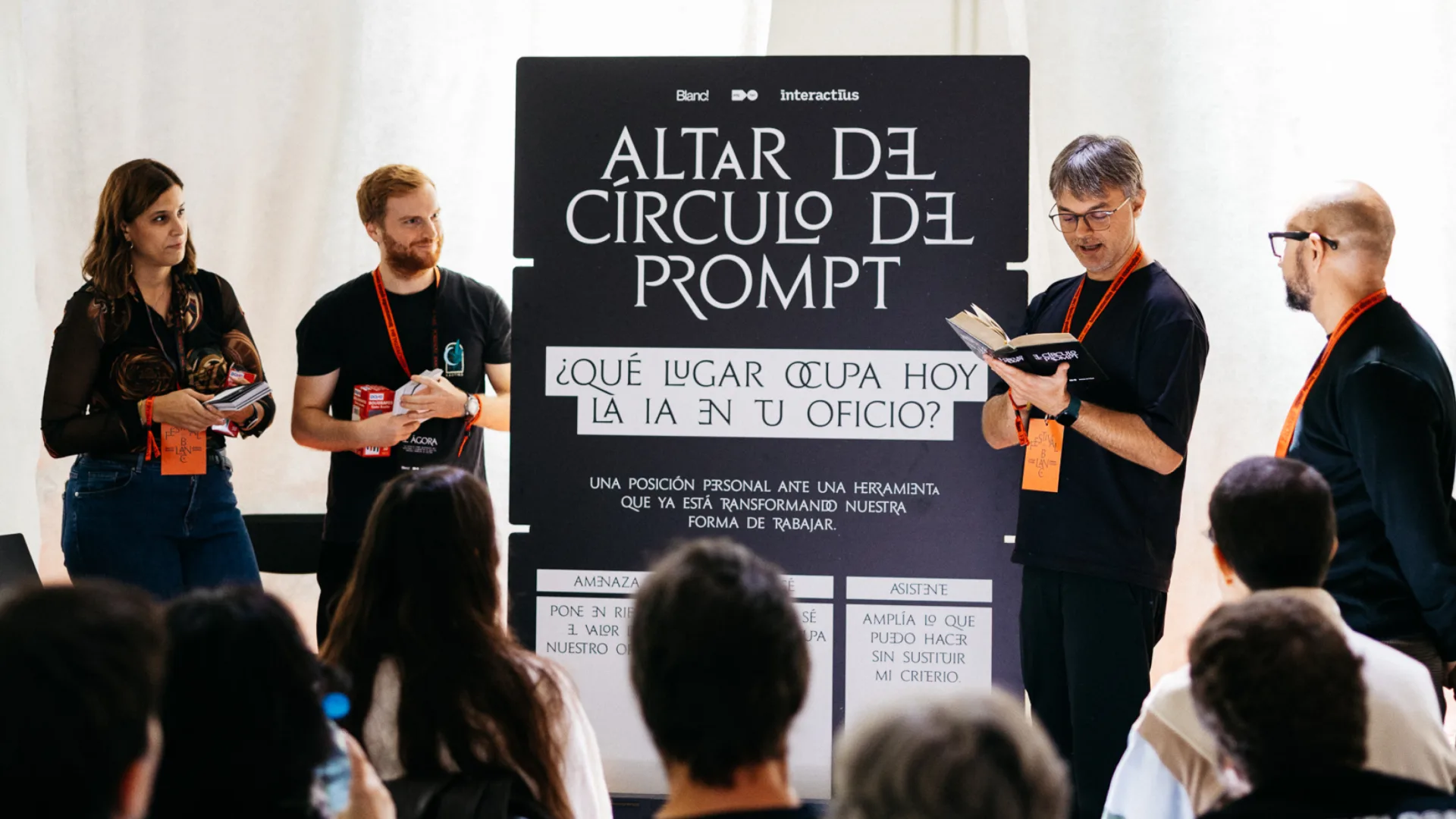
Àlex Gobern, president of ADG-FAD, opened the first circle with a direct question: what place does AI hold in your craft today? He started from the concerns a previous survey of the sector had surfaced (copyright, the FOMO around how fast the tools move, the fear of outsiders moving in) and put forward an idea: the easier production becomes, the more a designer's value shifts towards judgement.
The altar was emphatic. Across the three rounds, between 80% and 98% of the candles placed AI as an assistant, and the threat barely registered. But part of the room, almost one in five in the first round, chose «I don't know». That «I don't know» matters, because it is the door to what came next.
Nobody denied that AI multiplies speed. One person confessed to being «blown away» by how it breaks design's bottleneck; another, that AI had expanded so far that delegating now feels hard. The conversation had its flip side too: what are we losing? Writing, and rigour. «If they took AI away from me tomorrow I couldn't work», someone admitted, and another voice called it a trap: we get more done, but it can cost us in mental health.
The shared demand was clear: «I don't want AI doing the part I enjoy». Let it handle the mechanical work and leave us the exploration, the part that gives the craft its meaning.
I confess that…
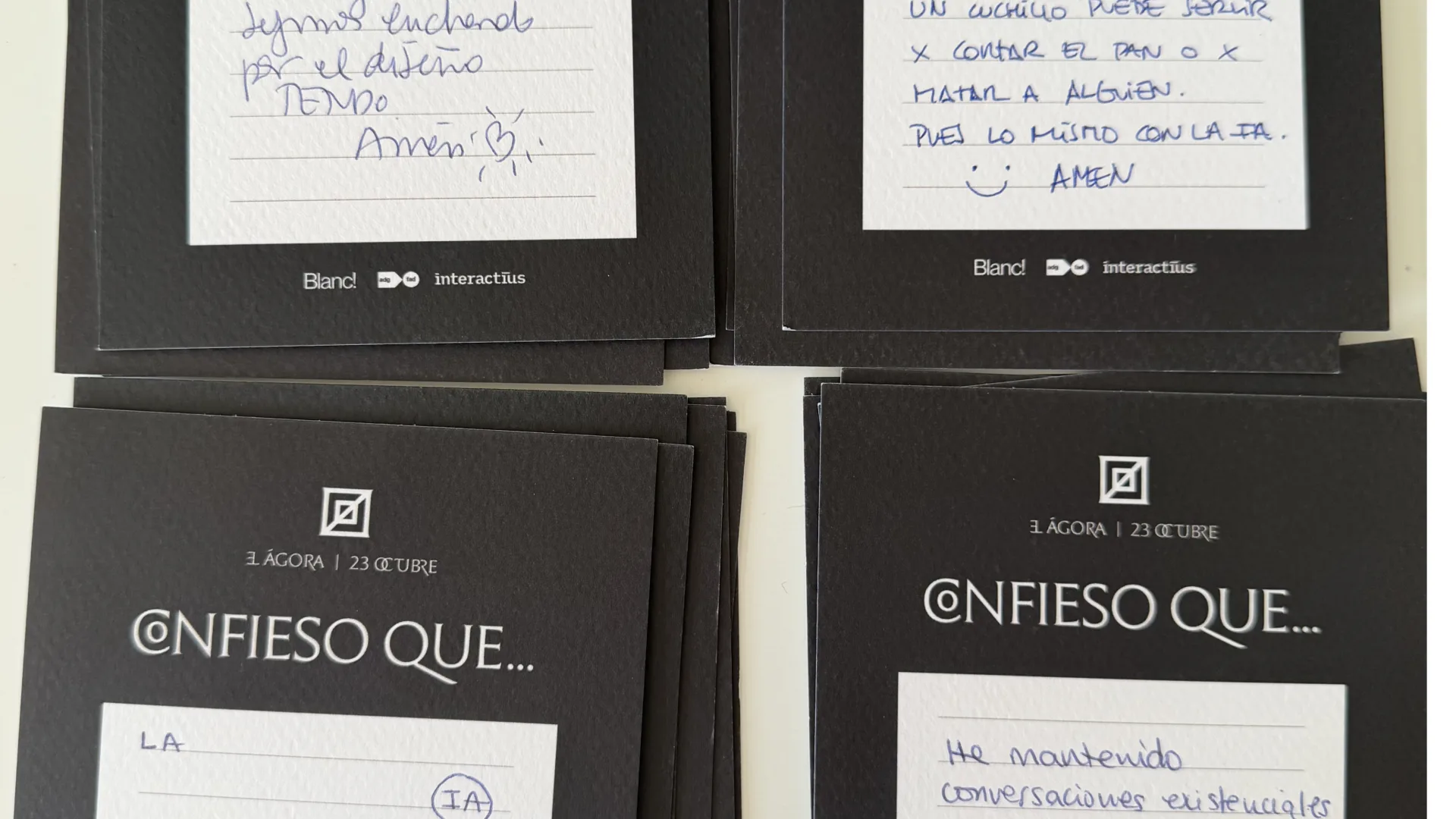
As well as taking a position at the altar, participants wrote an anonymous confession about their relationship with AI. We collected their cards, and what they say in private complicates what was voted in public.
Almost nobody fears AI taking their job. The fear is a different one: being left behind. «I feel like my grandmother when it comes to AI», «I don't know how to write a prompt», «It makes me want to go start a farm».
Alongside that worry comes the most repeated sin: delegating out of laziness. «I use ChatGPT when I can't be bothered to think», «It's been a year since I wrote an email myself word by word», «Everything I do, I ask AI for its professional opinion». Some even confessed to presenting ideas as their own that had come from the machine.
There was also a defence of the craft: «AI is not creative, and I don't think people realise it». And those who celebrate it without hesitation as «the best intern you'll ever have». There were even confessions that went beyond work: people who tell AI their problems for fear of what those around them would say, or who use it to be told they are right.
It makes for uncomfortable reading, but useful. In the circle it was said that judgement is all we have left; the risk is not that the machine takes it from us, but that we hand it over ourselves, one comfortable task at a time. The room put it better than anyone: if you use AI out of laziness, you are not going to grow.
The Circle of the Tribute: what we pay for the craft
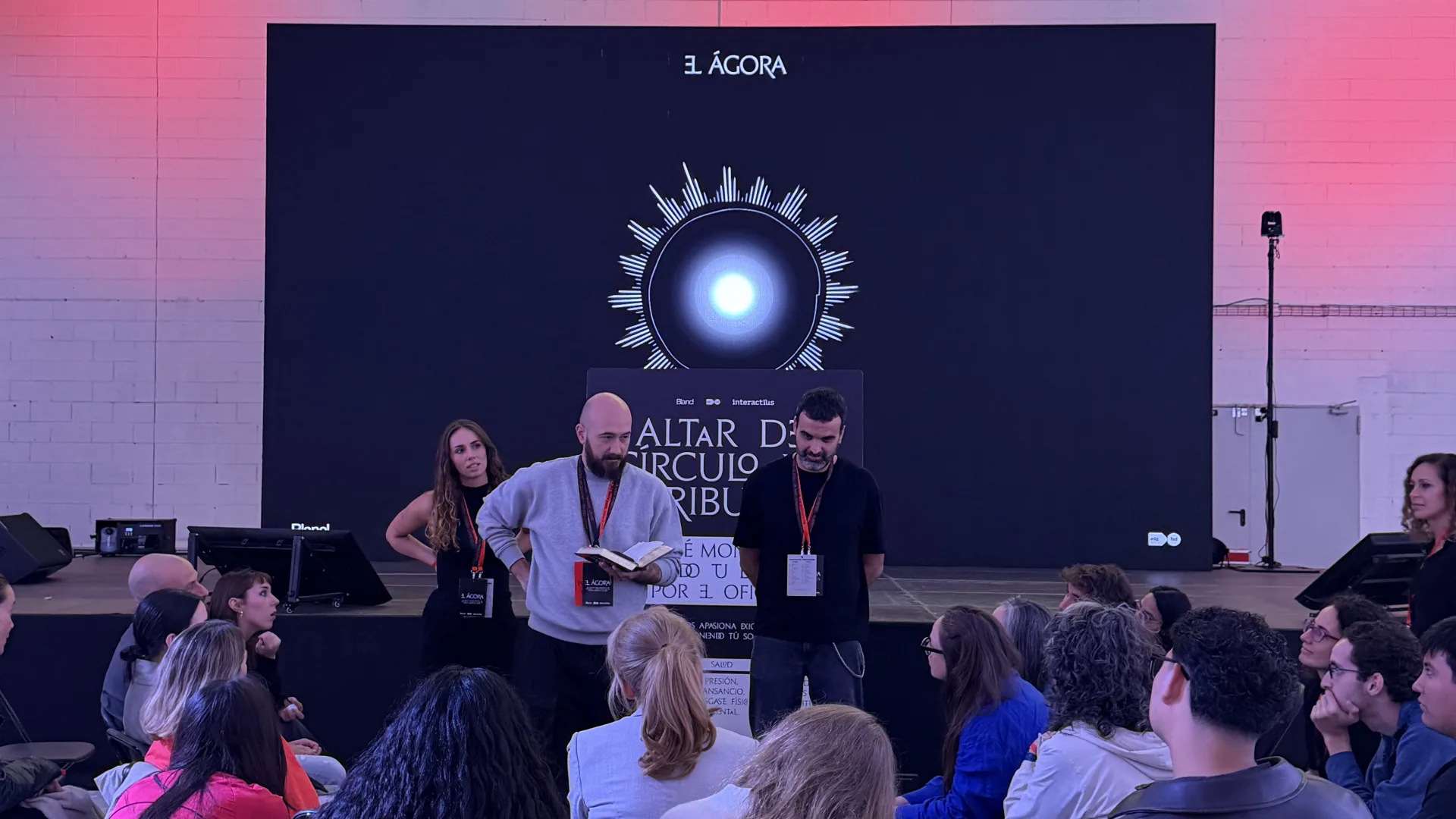
Coko Gabriel, founder of Not Found™ Agency and an ADG-FAD member, opened the second circle with a paradox: a profession that demands years of specialised training, often paid for privately, barely sees that investment reflected in its pay. And he laid part of the responsibility on the sector itself, which has allowed design to be seen as decoration rather than a business tool.
The altar's question was «what currency are you paying your devotion to the craft in?»: time, health or stability. But the most revealing moment came from a show of hands. Across the three rounds, almost everyone admitted to working more hours than they should and to feeling they are paid less than they are worth. Practically everyone had heard «that'll only take you a minute» at some point, and many had had to fight to get paid for work already delivered.
The phrases were just as telling: «I haven't had a weekend in 15 years», «It's taken me a lot of hours of therapy to understand the value of our work». People spoke about health suffering in a high-pressure sector, about the uncertainty of starting out, about training that, according to several attendees, teaches the same things it did fifteen years ago, and about how little we are taught to negotiate and sell ourselves.
What could have been a wall of complaints turned into something else. Veterans and people barely starting out shared experiences without filters and gave each other concrete advice on setting limits and losing the fear of saying no. «This is my price; if you don't want it, there are others». «Crying doesn't help, refocusing does».
Our infiltrator summed up each round in a single word: «therapy», «fellowship» and «the search for stability». The last one may be the most honest. Defending the value of what we do is not a matter of ego, it is the condition for the profession to be viable at all.
The Circle of the Sermon: why we struggle to explain
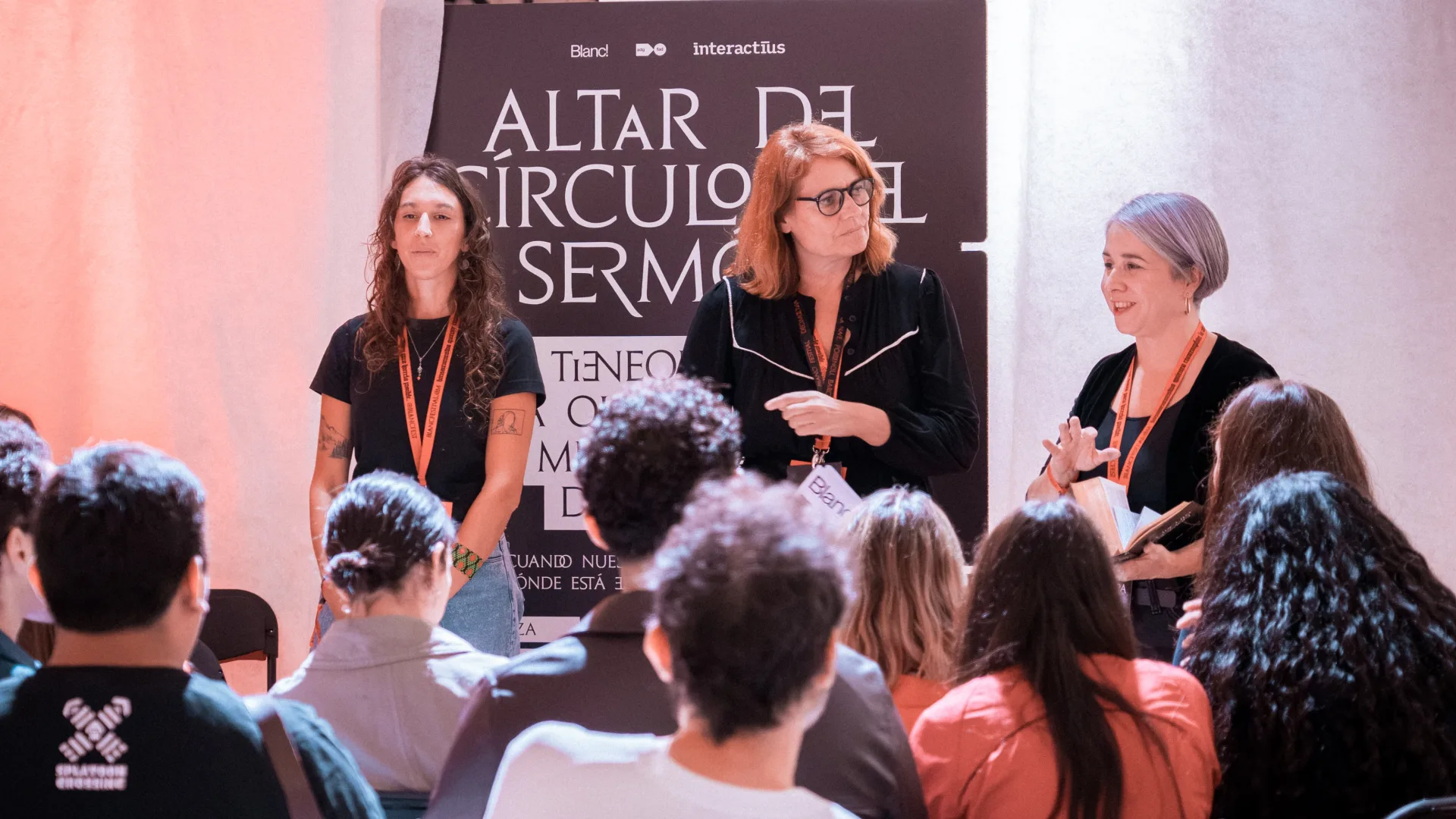
Íngrid Torán, founder of Blou and Rooi and vice-president of ADG-FAD, opened the third circle with the question the sector has been repeating for years: what has to change for the value of design to be better understood? Her starting point was the gap between the value we generate and our ability to explain it, and the need to stop justifying budgets or working by the hour and start talking about impact.
The room soon found its common grievance. Unlike architecture or medicine, where nobody disputes technical judgement, in design anyone with a visual tool to hand feels like an expert. «In the 13 years my company has existed, I still struggle to show the value of what we do», someone confessed. Another attendee reproduced a far too familiar exchange: «What do you do? Graphic designer. No, but what do you actually do?».
There was no consensus here, and that is the most interesting part. One group argued the problem starts with us: we present ourselves as people who execute pieces rather than people who solve problems, so it falls to us to act as teachers, and even therapists, with the client. Another group replied that we should not have to, because no other craft is asked for that explanation. Someone countered that we do not understand why the mechanic charges us so much either.
The debate landed on the practical: finding indicators that demonstrate impact, and not always economic ones but also engagement or perception; understanding what each client values and the vocabulary they speak; and accepting that context matters, because several attendees noticed that defending design in Catalonia is not the same as in Madrid or in Portugal.
Some shared what works for them: ever since they started explaining the whole creative process before quoting, more projects get accepted. And one person takes the strategy further: they run the client's brief through ChatGPT and show them both versions so they can see the difference. One sentence summed up the debate: «We say we design logos instead of saying we build brands».
What ran through all three circles
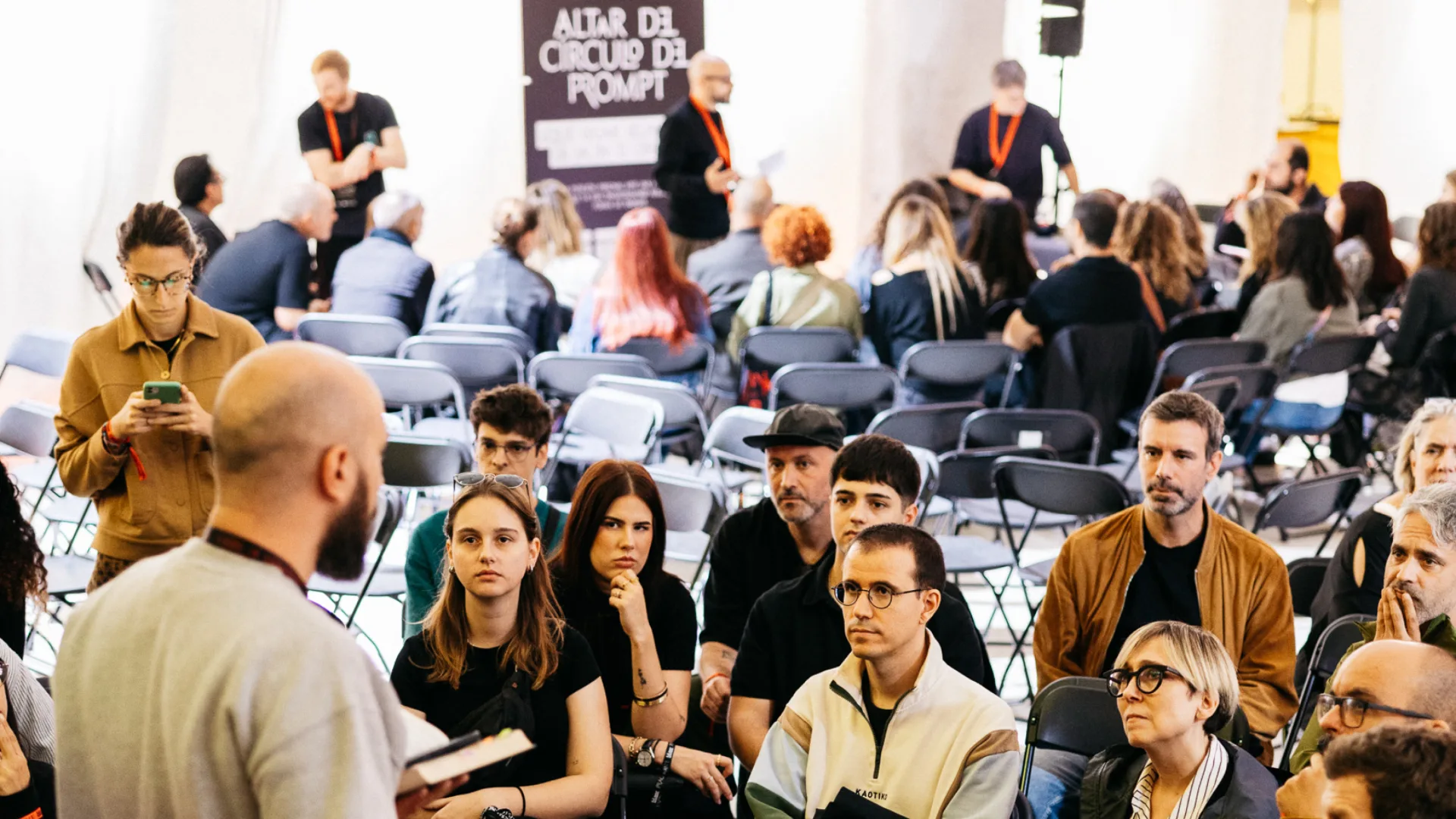
Listening to the attendees we discovered something we had not anticipated: AI did not stay in its own circle. It turned up in the other two as well. In the Tribute, as one more pressure on what you can charge. In the Sermon, as one more rival against which to justify the value of our work.
But in more than one circle the opposite story came up too: clients who tried to solve it with AI and ended up coming back. A website that was not what they expected. A design made with ChatGPT that could not go to print.
The Ágora's three themes turned out to be one: how to sustain the value of human judgement when producing is ever easier, faster and cheaper. There is no single answer, but there is a shared clue: value is not defended by the artefact alone, but by explaining the process and the decisions behind it.
The closing: the final revelation
At the end, El Diseñor took the floor again. His sermon gathered what had been said in the three circles and gave it back to the room as liturgy. On AI: «Do not let the machine do what you love. Let it do what steals your time». On the price we pay for the craft: «That is not devotion, faithful ones. That is penance. And I never asked it of you». And underneath it all, the question that ran through the Ágora: do we still believe in this?
«Three circles. One same answer. Yes. We still believe in this. With doubts, with tiredness… but believing.»
If there is one thing we take from this edition, beyond the numbers, it is what happens when professional labels are suspended. As each circle ended, the conversation refused to stop: attendees carried on debating in the corridors, swapping contacts and offering each other help off script. Designing a frame for encounter served exactly that purpose: letting people who share a craft, its contradictions and its uncertainties talk without filters again.
Thank you to David D'Eboli and to Blanc! for trusting us, to ADG-FAD for joining us on this adventure, to Àlex Gobern, Coko Gabriel and Íngrid Torán for being part of the experience, and to everyone who sat down, voted, confessed and argued. Blanc! proves every year that a design festival can be far more than a showcase: a place where the sector looks at itself honestly. See you at the next edition. And, as El Diseñor sent us off: go in peace… and charge what you are worth.
Appendix: El Diseñor's confessional
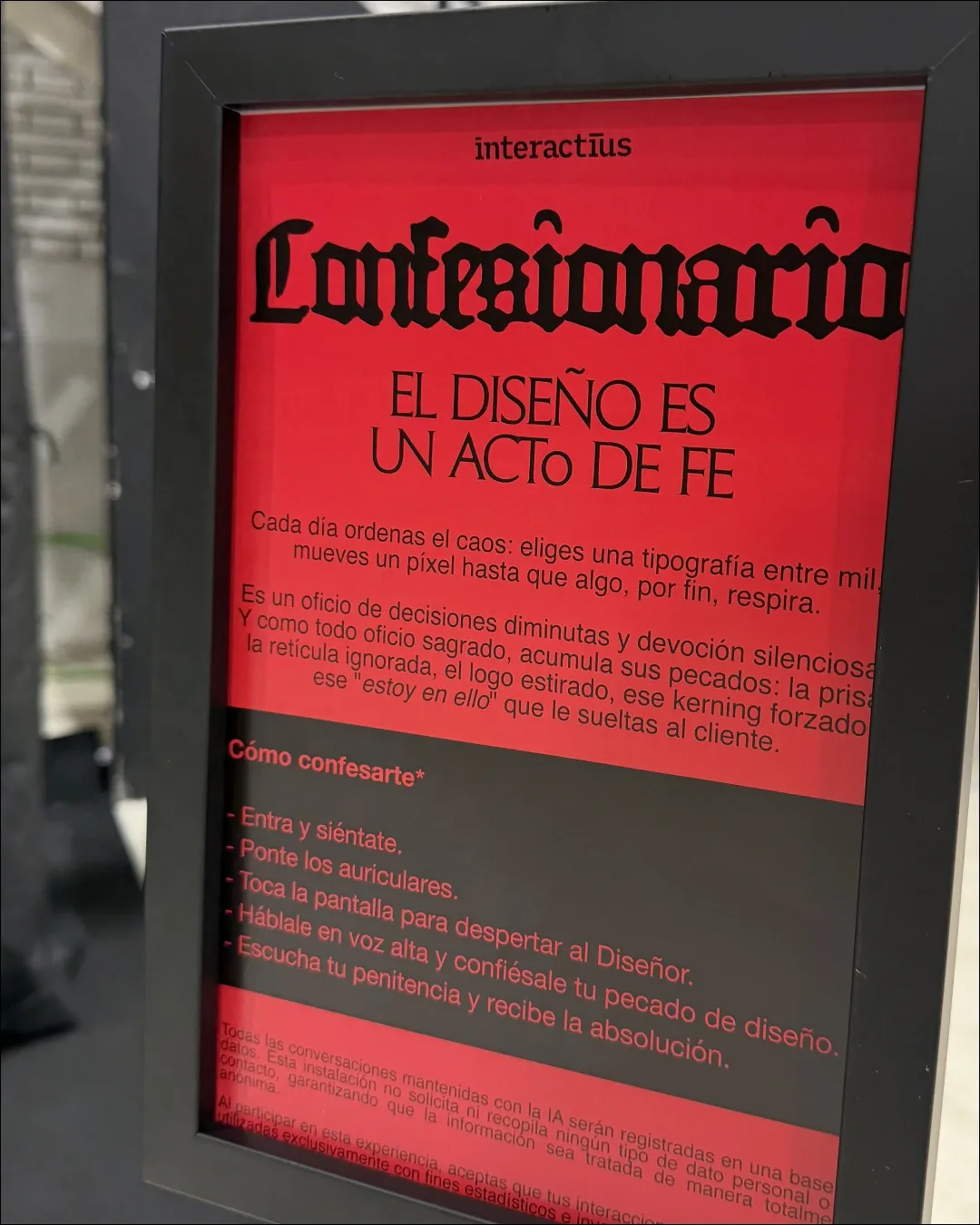
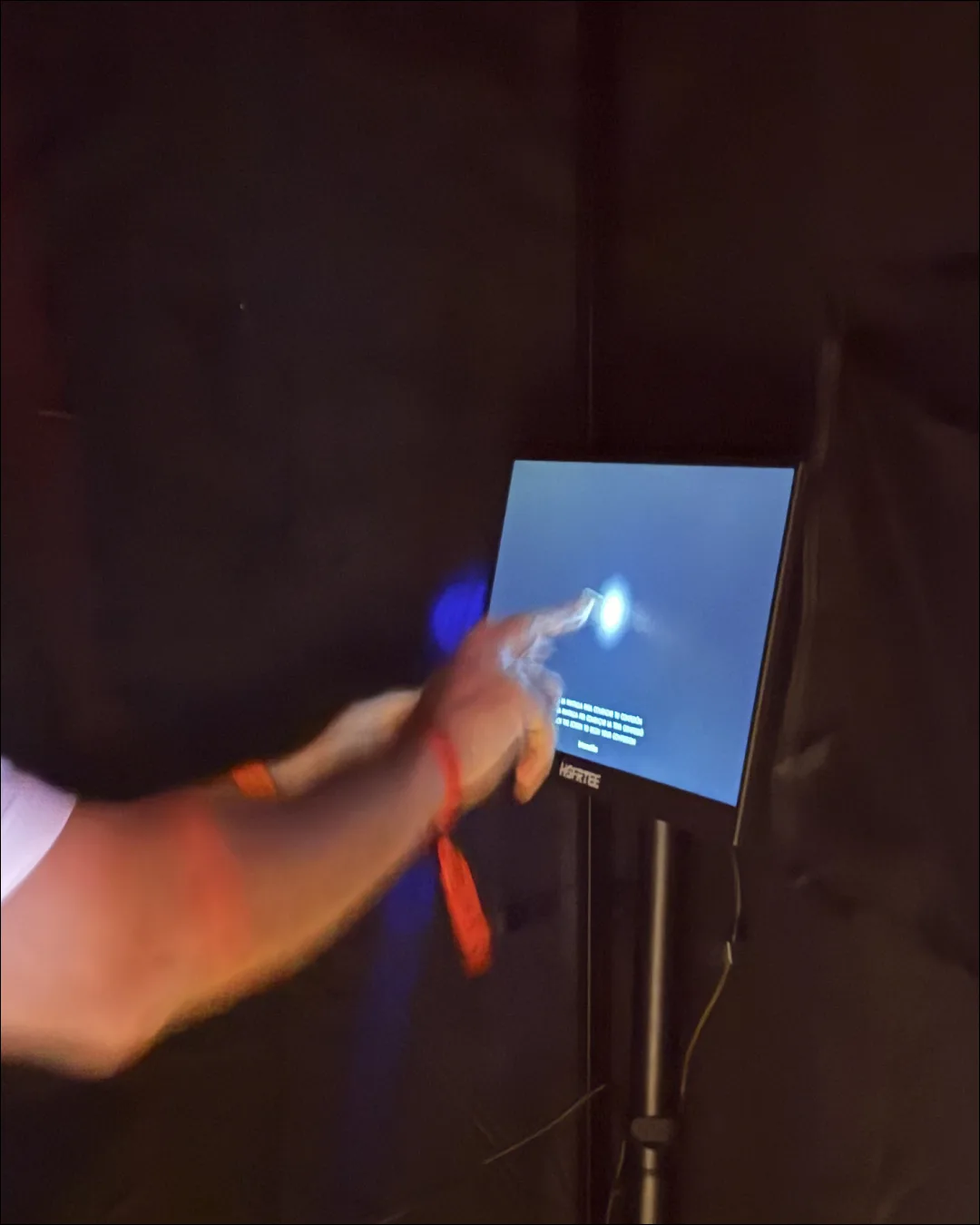
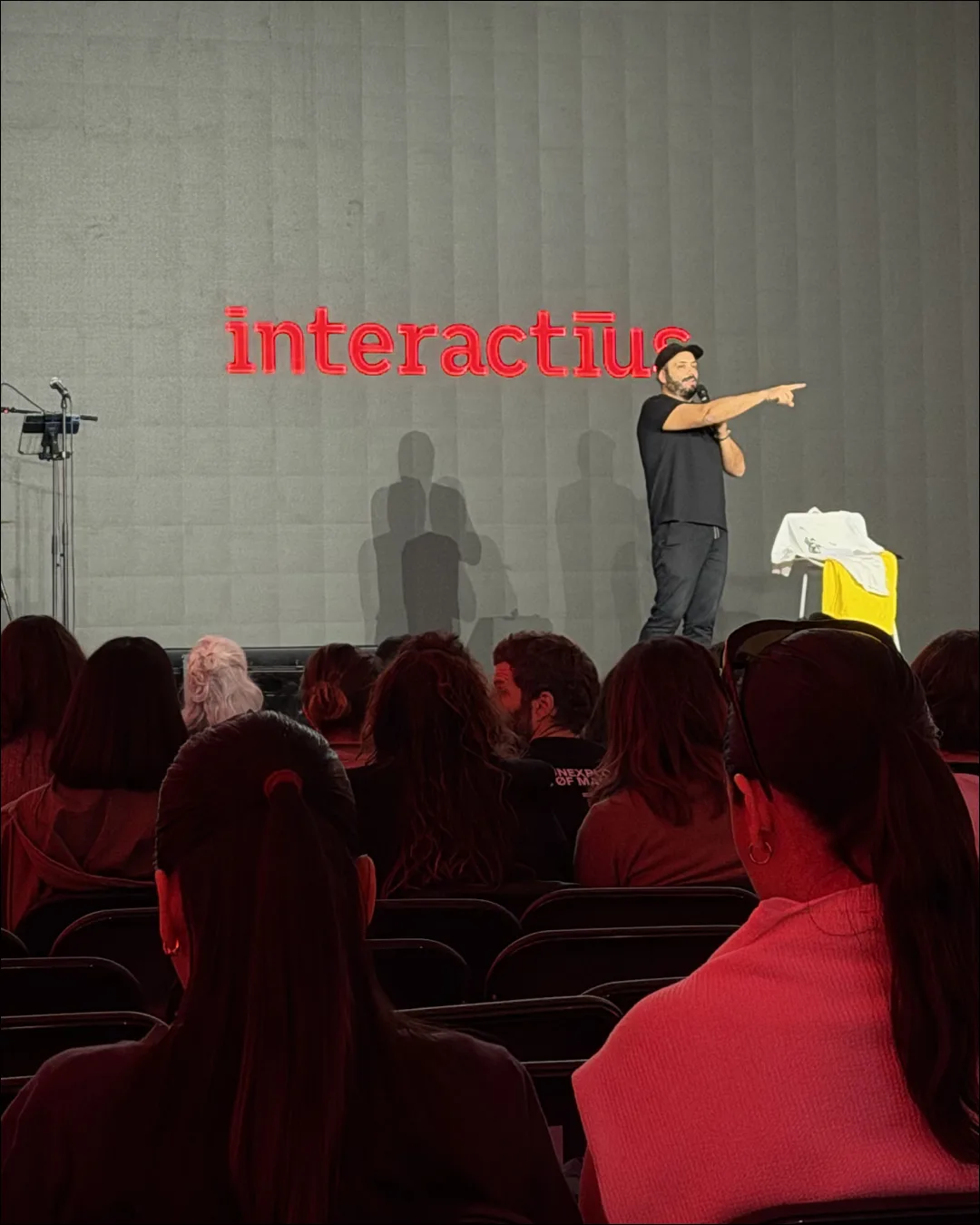
Beyond the Ágora, El Diseñor had a space of his own at the festival: a private confessional that stayed open across both days of Blanc!, designed to suspend judgement and strip away professional posturing. We built it by synthesising his voice and bringing him to life with an AI agent trained on real knowledge about how designers work today, market trends and the character's own personality. The ritual was simple: go in, sit down, put the headphones on and touch the screen to wake him. From there, a conversation out loud, alone with him.
«You have crossed the threshold. The sanctuary receives you in the half-light. I am El Diseñor, the one who hears what no client should. Tell me, creative soul… what design sin have you come to purge today?»
El Diseñor heard 150 confessions and was shocked by none of them. Most were exactly what he promised: design sins confessed and absolution received, from admitting that brand guidelines go unread to sharing the uncertainty running through the craft today. But listening back, three big themes repeat: tools, with Figma at the front; creative block; and anxiety about professional futures, the same one that surfaced in the Ágora's circles.
And some went in and barely managed to say anything. Perhaps because speaking out loud to a machine, even alone, still feels like a lot.
Even so, the confessional proved something: what the craft probably needs most right now is a place where admitting our sins carries no cost and no judgement.
Another year, thank you Blanc!
